Program brings life back to coastlines
Landlords have raised rents this winter for apartments along Sanya Bay in Sanya, a renowned resort in tropical Hainan province that sees up to 100,000 tourists a day during major holidays.
And they have good reason: the beaches have been expanded and filled with good quality sand, more trees have been planted and more birds can be seen flying and dancing over the sea.
"We don't care about the rent increases because we have a better environment and enjoy ourselves more here than before," said Lao Wang, from northeastern Jilin province, who "flies south" with his wife to Sanya during winter.
Wang was among the beneficiaries of Sanya's national pilot city betterment and ecological restoration programs initiated by the central government in April last year as a new approach to the sustainable social and economic development of Chinese cities.
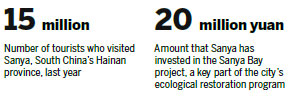
Originally a fishing village, Sanya, favored by its unique location and natural resources, has seen rapid growth in tourism and urbanization, with its population doubling from 300,000 when it became a city in 1988 to more than 600,000 today. In 2015, the city received about 15 million visitors from home and abroad.
Rampant growth has led Sanya to suffer from common city problems such as ecological deterioration, water pollution and construction chaos.
"The real nature of city betterment and ecological restoration is a way of thinking aimed at promoting the upgrading of urban planning and development concepts and progress in city management policies," said Zhang Bing, chief planner of the China Academy of Urban Planning and Design, who has been in charge of the general design and planning of Sanya's pilot programs.
Sea and the coastlines are the "soul" of Sanya. The Sanya government started its ecological restoration efforts by saving the coastlines in April last year.
Zhang Huazhong, director of the city's marine and fishery bureau, said that Sanya has invested about 20 million yuan ($3.03 million) in the Sanya Bay project, a key part of the restoration program. Through bringing in new sand, about 2.6 kilometers of beaches have been returned to their original state and a large number of mangroves, which are salt-resistant, windproof and good for stabilizing the sand, have been planted along the coast.
Another important part of Sanya's ecological restoration program is curbing the pollution of the city's rivers and streams. By the end of June, the city had built 58 km of sewage pipelines and 19 sewage treatment facilities.
More than 200 aquaculture farms that contribute to pollution in the waterways were shut down, according to Chen Lin, an official with the city's water resources bureau.
The efforts are bearing fruit. Rare marine species like the Chinese white dolphin have been discovered along Sanya's shores, indicating the water quality of Sanya Bay is getting better and there are more fish - the food of dolphins.
Wang Tieming, vice-mayor of Sanya, said: "This is only the beginning of our city development and management transformation. We will strictly carry out the general plans to build a happy city for the people and put Sanya on a real green and sustainable track."
"Sanya has a long way to go. But it still can serve as a good demonstration for other cities in that the local government now has a very clear understanding that the relationship between people and nature must be restored and it is now time to seek quality growth for the city," said Zhang, the chief planner.
"The city has succeeded in mobilizing all social sectors, government organs, enterprises, social organizations and even children to be involved in the city betterment and ecological programs in their own ways," Zhang said, adding that the city has laid a solid foundation for the continuation of the city betterment efforts by establishing basic legal rules to ensure long-term success.
mazhiping@chinadaily.com.cn
|
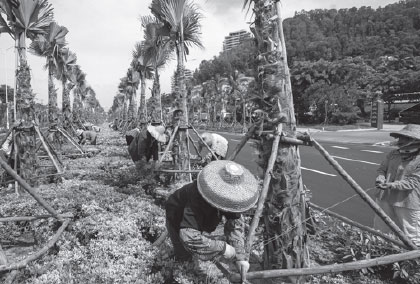
Workers fasten trees on Fenghuang Road in Sanya, Hainan province, in October. Wu Haoning / For China Daily |
(China Daily USA 12/12/2016 page6)