HK residents face 'make or break' choice
Updated: 2014-09-05 07:51
By Dan Steinbock(China Daily)
|
||||||||


Through the summer, Hong Kong was caught in the web of soaring political heat, "Occupy Central"-sponsored "polls", marches and deepening divisions. Following a series of political rallies, Hong Kong Financial Secretary John Tsang said that, in the absence of political stability, such an environment could lead to a "perfect financial storm".
As a small and highly open economy, Hong Kong is also heavily influenced by global developments, particularly the tapering of quantitative easing (QE) by the US Federal Reserve and China's economic transition. With the Fed expected to hike policy rate by mid-2015, if not earlier, Hong Kong should benefit especially if the QE tapering leads to a recovery in US demand. But unlike in the past, this is no longer a sure thing, because weakened consumption and slower appreciation of housing prices, along with the aging population, continue to hamper US growth.
In the case of China's transition, the "fast implementation" of economic reforms might slow down the mainland's economic growth in the near term but in the long run it will boost growth, which would benefit Hong Kong immensely through trade and financial channels. Nevertheless, Hong Kong's self-induced political uncertainty could add to external risks.
The mainland is Hong Kong's largest export and import partner. Some 75 percent of the inflows of foreign investment can be traced to the mainland and Chinese companies. Last year, Hong Kong received 55 million foreign visitors, of which 75 percent were from the mainland. And Hong Kong has become the main offshore renminbi center.
So without the mainland, Hong Kong would be left with only half of its trade, one-fourth of its foreign investment and visitors, and only one-tenth of its water and food supply. Also, Hong Kong's offshore renminbi center will thrive but only as long as it is attractive to mainland companies' fund-raising activities.
In the next three years, Hong Kong residents will choose between integration and inclusive growth on one side and instability and corrosive decline on the other. It is a choice that has the potential to make or break Hong Kong.
The author is research director of international business at India China and America Institute (US) and visiting fellow at Shanghai Institutes for International Studies (China) and the EU Center (Singapore).
 Music at her fingers
 Across America Over the Week (Jan 16 - Jan 22)
 Spend Chinese New Year in style
 Ili river valley becomes a popular destination for swans
 Philip Ma: from scientist to businessman
 Birmingham's Spotlight on China dinner
 How to distinguish doucai, wucai, Famille-rose and enamel porcelain
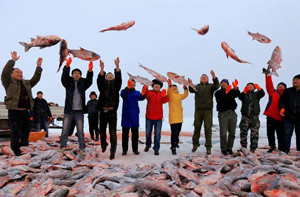 Xinjiang lake in bumper fishing season
Most Viewed
Editor's Picks
|

|


|

|
|
|
Today's Top News
Houston's SW Chinatown
China to focus on reforms, opening of capital market
Slowdown brings new risks to banks
Trade group calls for BIT
Market status for China is 'political' issue
Birmingham's Spotlight on China dinner
Bank takes renminbi-clearing seriously
Traditional Garb
US Weekly

|

|