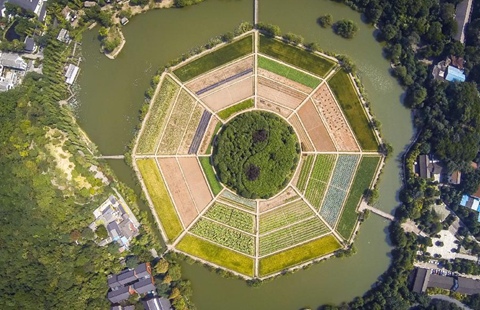
Tale of two cities and ghost towns
Updated: 2014-10-10 07:36
By Andrew Sheng and Geng Xiao(China Daily)
|
||||||||


Many observers regard the rise of the unoccupied modern "ghost towns" in China, which have been funded through risk-laden local government financing vehicles, as symptoms of a coming collapse. But this view underestimates the inevitability - indeed, the necessity - of such challenges on the path to development.
In 2012, the venture capitalist William Janeway argued that economic development is a three-player game involving the state, private entrepreneurial innovation, and financial capitalism, with inevitable cyclical overshoots that create the conditions for the next wave of invention and output growth. The United States had ghost towns once it began investing in railways, mining, and industrialization in the mid-19th century. But it experienced no systemic crisis.
Without large-scale infrastructure investment, especially in transport, the productivity gains that enabled the US' emergence as an industrial power would not have been possible. Though the process included significant creative destruction, the rapid economic growth offset losses resulting from excess capacity.
Similarly, when viewed through the long lens of history, China's ghost towns will prove to be merely potholes on its development road. China's massive infrastructure investment, funded largely through LGFVs, will most likely be remembered for its critical contribution to the country's economic modernization.
Of course, the translation of infrastructure investment into economic progress is not guaranteed. The new infrastructure - together with on-the-job training that enables Chinese workers to manage it effectively - must boost the country's productive capacity sufficiently to offset the value destruction from obsolete fixed assets and underemployment.
In this sense, China's prospects are promising. As it stands, the total value of infrastructure investment in China amounts to only about 240 percent of GDP, less than half of Japan's 551 percent - and with a much younger population. China's capital stock remains below $10,000 per capita; that figure is above $90,000 in the US and more than $200,000 in Japan (at 2011 prices).
Moreover, roughly 1 percent of China's population - about 12 million people - migrate from rural to urban areas each year. Unrelenting demand for modern, innovative infrastructure that supports citizens' livelihoods, improves energy efficiency, and minimizes pollution cannot simply be ignored - especially given urbanization's central role in driving economic modernization and productivity gains.

 Music at her fingers
 Across America Over the Week (Jan 16 - Jan 22)
 Spend Chinese New Year in style
 Ili river valley becomes a popular destination for swans
 Philip Ma: from scientist to businessman
 Birmingham's Spotlight on China dinner
 How to distinguish doucai, wucai, Famille-rose and enamel porcelain
 Xinjiang lake in bumper fishing season
Most Viewed
Editor's Picks

|

|


|

|

|

|
Today's Top News
Houston's SW Chinatown
China to focus on reforms, opening of capital market
Slowdown brings new risks to banks
Trade group calls for BIT
Market status for China is 'political' issue
Birmingham's Spotlight on China dinner
Bank takes renminbi-clearing seriously
Traditional Garb
US Weekly

|

|