Window on China for the West
Updated: 2014-12-05 08:16
By Helmut Schmidt(China Daily)
|
||||||||


After 35 years of rapid growth since 1978, China now ranks second in the world in terms of economic aggregate. Within a few years it will take first place - this expectation being based on the fact that the country and its governing body remain relatively stable. Having faith in China's growth model, the new generation of Chinese leadership with President Xi Jinping at the head also needs to deal with the important, strenuous and complicated tasks brought about by the country's high-speed economic development. By 2020 the per capita income of urban and rural residents in China will be double that of 2010.
China will continue to improve and develop socialism with Chinese characteristics, and promote modernization of the State governance system and its governing capacity, so as to lay a solid institutional foundation for the country's development in the long run. It will promote new industrialization, informationization, urbanization and agricultural development, and encourage investment and consumption at the same time. It must also reform its financial sector. President Xi will pay special attention to problems caused by corruption, environmental pollution, illegal occupation of land, labor disputes, and threats to food safety.
Reducing smog in China's major cities is an urgent issue. The factors contributing to the smog are complicated, and implementing control measures on different fronts requires a huge budget, which might affect power supply to the public, or their incomes. The government's climate policy will also be part of the process. At a time when calls to curb global warming get louder, China cannot back away.
Another serious issue for China is that its rapid urbanization process is accompanied by an aging population and a national network for old-age care is imperative under the circumstances. China will also have to reconsider its one-child policy. The household registration system also calls for adjustment.
People visiting China today will notice that the country is pressing forward with reform in many areas. The rights of migrant workers are better protected, and there are larger and more successful agricultural enterprises in the market. Comparing China from Mao's era 40 years ago to today's China, one can see that the space for development, freedom and other civil rights has greatly expanded.
Undoubtedly, China has realized the harmonious coexistence of tradition and modernization. For 2,500 years the Chinese have honored the rational ethics of Confucianism. For at least 1,000 years until the early 20th century, China was ruled by feudal bureaucrats, and Confucianism was the governing school of thinking. After it took control of the country in 1949, the Communist Party of China swept away Confucianism. However, in today's China, Confucianism is making a return as a philosophy that is imbedded within the Chinese minds. The interpretation of Confucian principles by President Xi shows that China is becoming ever more confident in its culture.
In a country the size of China, cohesiveness is central. But placing one's hopes on nationalism can backfire, as this will probably lead to crisis or even war, while the Chinese civilization, with its history and substance, will do a better job at boosting the confidence and purposefulness of the Chinese. During the 5,000-year course of Chinese culture, there has rarely been any trace of imperialist thinking, and China has always honored peace above all else. A good example of this is that according to Chinese historical records General Zheng He, the 15th-century Chinese mariner and explorer, did not take advantage of his fleet's military superiority when visiting foreign countries.
After World War II the Western European countries gradually adopted a more rational attitude towards China. Over time the continents of Europe and Asia became closer in economic fields, which was a positive development. The European Union is now China's biggest trading partner, and China is the second-largest partner of the EU. China-Germany relations are also at their strongest ever.
It is a matter of regret for me though, that the Chinese leadership has always had a better understanding of the West than vice versa. The publishing of Xi Jinping: The Governance of China represents a positive attempt to change the status quo. The book allows foreign readers to understand the philosophy adopted by China's leadership, and the strategic guidelines on which direction China's development is heading. As such, it offers the world a better understanding of China's development, especially its policies on governance and diplomacy. It is President Xi's hope that China realizes the Chinese Dream of the great rejuvenation of the Chinese nation, and for this China must find its own path and once again become a world power. A book like this will help foreign readers to gain a better and more objective understanding of China from historical and other perspectives.
The West often finds it hard to suppress the impulse to act as a lecturer with regard to China and its leaders, which usually results in failure stemming from ignorance and arrogance. The West needs to apply more common sense, abandon its condescending attitude and let fair play apply.
The author, the former chancellor of Germany, is commenting on the book Xi Jinping: The Governance of China.

 Music at her fingers
 Across America Over the Week (Jan 16 - Jan 22)
 Spend Chinese New Year in style
 Ili river valley becomes a popular destination for swans
 Philip Ma: from scientist to businessman
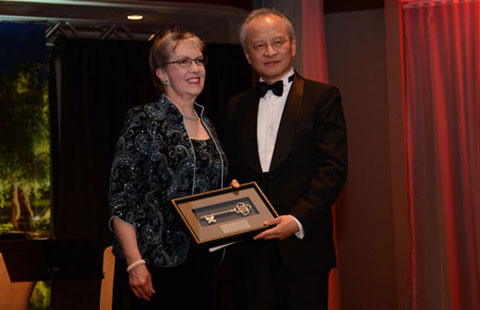 Birmingham's Spotlight on China dinner
 How to distinguish doucai, wucai, Famille-rose and enamel porcelain
 Xinjiang lake in bumper fishing season
Most Viewed
Editor's Picks
|
|


|

|

|
|
Today's Top News
Houston's SW Chinatown
China to focus on reforms, opening of capital market
Slowdown brings new risks to banks
Trade group calls for BIT
Market status for China is 'political' issue
Birmingham's Spotlight on China dinner
Bank takes renminbi-clearing seriously
Traditional Garb
US Weekly

|

|