How fast will China grow over the next five years?
Updated: 2014-12-22 07:47
By Justin Yifulin(China Daily)
|
||||||||


But potential growth is just one part of the story. Whether it can be achieved depends on domestic conditions and the international environment. In order to exploit its latecomer advantage, China must deepen its reforms and eliminate its economy's residual distortions. Meanwhile, the government should play a proactive role in overcoming the market failures - such as externalities and coordination problems - that are certain to accompany technological innovation and industrial upgrading.
China has the potential to maintain robust growth by relying on domestic demand - and not only household consumption. The country suffers no lack of investment opportunities, with significant scope for industrial upgrading and plenty of potential for improvement in urban infrastructure, public housing and environmental management.
Moreover, China's investment resources are abundant. Combined central and local government debt amounts to less than 50 percent of GDP - low by international standards. Meanwhile, private savings in China amount to nearly 50 percent of GDP, and the country's foreign exchange reserves have reached $4 trillion. Even under comparatively unfavorable external conditions, China can rely on investment to create jobs in the short term; and as the number of jobs grows, so will consumption.
The external scenario, however, is gloomier. Though developed countries' authorities intervened strongly in the aftermath of the global financial crisis in 2008, launching significant fiscal and monetary stimulus measures, many of their structural shortcomings remain unresolved. "Abenomics" in Japan has yet to yield results, and the European Central Bank is following in the footsteps of America and Japan, pursuing quantitative easing in an effort to shore up demand.
Employment in the US is growing, but the rate of workforce participation remains subdued and the economy has yet to attain the 6 to 7 percent growth rates usually recorded in a post-recession rebound. The US, Europe, and Japan are likely to experience continued sluggish performance, inhibiting China's export growth.
As a result, Chinese growth is likely to fall below its potential of 8 percent a year. As policymakers plan for the next five years, they should set China's growth targets at 7 to 7.5 percent, adjusting them within that range as changes in the international climate dictate. Such a growth target can help to stabilize employment, lower financial risks, and achieve the country's goal of doubling incomes by 2020.
Justin Yifu Lin, a former chief economist and senior vice-president at the World Bank, is professor and honorary dean of the National School of Development, Peking University.

 Music at her fingers
 Across America Over the Week (Jan 16 - Jan 22)
 Spend Chinese New Year in style
 Ili river valley becomes a popular destination for swans
 Philip Ma: from scientist to businessman
 Birmingham's Spotlight on China dinner
 How to distinguish doucai, wucai, Famille-rose and enamel porcelain
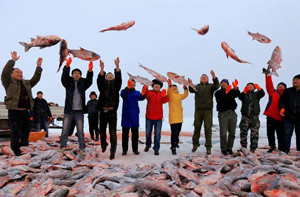 Xinjiang lake in bumper fishing season
Most Viewed
Editor's Picks

|

|


|

|

|

|
Today's Top News
Houston's SW Chinatown
China to focus on reforms, opening of capital market
Slowdown brings new risks to banks
Trade group calls for BIT
Market status for China is 'political' issue
Birmingham's Spotlight on China dinner
Bank takes renminbi-clearing seriously
Traditional Garb
US Weekly

|

|