Ruble concern not yet over
Updated: 2014-12-27 08:51
By Cheng Yijun(China Daily)
|
||||||||


First, the recovering US economy has strengthened the dollar, which would have a depreciatory effect on other currencies, especially those of major economies such as Russia.
The continuing fall in oil price (from nearly $107 a barrel in June to about $56 a barrel on Dec 23) has worsened the Russian government's problems because it depends heavily on oil exports for its revenue.
Second, the flight of international capital from Russia that began last year after the West imposed economic sanctions on Moscow for its alleged involvement in the Ukraine crisis has dealt another blow to the country's economy, because the resultant dearth of foreign currencies forced the country to undersell a large amount of rubles.
Earlier this month, US lawmakers further complicated matters for Russia by passing the Ukraine Freedom Support Act aimed at providing military and non-military aid to Ukraine and impose fresh sanctions on Moscow. International speculative capital swooping out to make profits from the depreciating ruble too have played a role in the fall of the Russian currency.
Of course, Russia's sluggish economy should be primarily blamed for the recent troubles, which in turn, have diminished Russians' confidence in the ruble and the benefits of trade with foreign countries.
Because of the sizable depreciation of the ruble and rising inflation, Russia's "de-dollarization" countermeasure to deal with the Western sanctions and reduce its dependence on the US dollar too could be in jeopardy.
The spillover effect of the ruble's slide has already been felt by China's Geely Automobile Holdings, whose shares fell 17 percent to HK$2.59 in Hong Kong on Dec 17, because of its sluggish sales in Russia, its major overseas market. Besides, tourism between the two countries is expected to suffer, for many Russians can no longer afford holidays in China.
It will take some time for the ruble to become stable given the latent recession in Russia. But it is still too early to say Russia urgently needs China's financial assistance to tide over its currency crisis.
Being a country with the third-highest foreign exchange reserves and with abundant administrative measures at hand, Russia today is more adept at handling the ruble's depreciation than it was during the 1998 financial crisis.
The author is a researcher at the Institute of Russian, East European and Central Asian Studies, affiliated to the Chinese Academy of Social Sciences.

 Music at her fingers
 Across America Over the Week (Jan 16 - Jan 22)
 Spend Chinese New Year in style
 Ili river valley becomes a popular destination for swans
 Philip Ma: from scientist to businessman
 Birmingham's Spotlight on China dinner
 How to distinguish doucai, wucai, Famille-rose and enamel porcelain
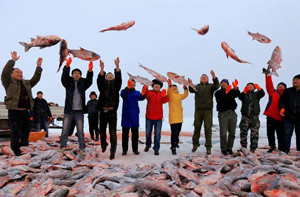 Xinjiang lake in bumper fishing season
Most Viewed
Editor's Picks

|

|


|

|

|

|
Today's Top News
Houston's SW Chinatown
China to focus on reforms, opening of capital market
Slowdown brings new risks to banks
Trade group calls for BIT
Market status for China is 'political' issue
Birmingham's Spotlight on China dinner
Bank takes renminbi-clearing seriously
Traditional Garb
US Weekly

|

|