The enigma that was 'Vinegar Joe'
Updated: 2015-03-06 11:40
By Zhao Xu(China Daily USA)
|
||||||||


 |
|
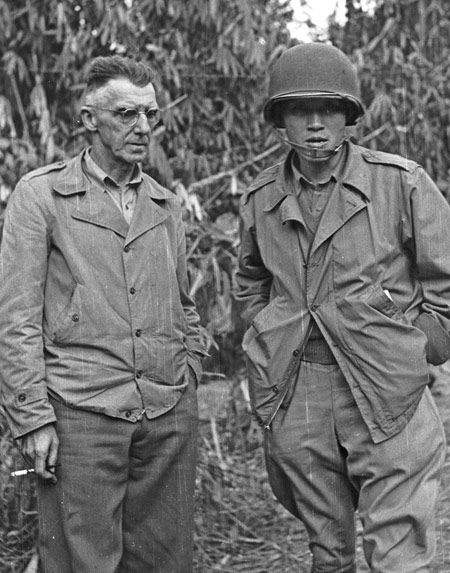
General Stilwell poses with a Chinese soldier in the China-Burma-India Theater during World War II. Provided To China Daily |
Winning hearts and minds
"The skills taught at the rehabilitation camps included tinsmithing, sewing, carpentry and such," said John Easterbrook, pointing to a photograph in which Stilwell, hat in hand, is seen talking with a group of Chinese soldiers, most of whom are on crutches after losing limbs.
According to Ge Shuya, a historian who specializes in the CBI Theater, the criticism Stilwell received both in life and death - among other things, he was condemned for being too harsh on US soldiers and refusing to evacuate some deemed unfit to fight - can partly be explained by his determination to win the hearts and minds of the Chinese soldiers.
"Stilwell understood the Chinese mentality well enough to know that to become the true leader of those soldiers, he would have to fight alongside them and demonstrate a high level of fairness toward everyone, Americans and Chinese, which he did," Ge said. "In the battle for Myitkyina, the Burmese city-cum-airfield, Stilwell insisted that the US soldiers stick with their Chinese counterparts to the end. That meant four protracted months of hard, bloody fighting during the monsoon season."
It was at Stilwell's insistence that the "Ledo Road" was built between 1943 and 1944 to link the southwestern city of Kunming, Yunnan Province, with Assam in India and reopen China's overland supply route, which had been cut by the Japanese in early 1942.
The project was controversial, and contributed to a widely publicized dispute between Stilwell and his CBI subordinate, Claire Chennault - commander of the "Flying Tigers" squadrons of US pilots that operated in China. Chennault was promoted to the rank of lieutenant general just days before he died. He was convinced that aerial assaults would be enough to overpower the Japanese.
"Keeping in mind that the Ledo Road was officially opened in January 1945, just seven months before the Japanese surrender in August, it's true that it never really delivered the tonnage of supplies envisaged. But in the process of forcing this route through northern Burma, Stilwell had helped to train and equip 30 Chinese divisions, many of which later fought the Japanese elsewhere in China," Ge said. "Stilwell was always an active proponent of the improvement of the Chinese army."
However, by the time the Ledo Road - later renamed Stilwell Road by Chiang Kai-shek - was opened, the general had already been recalled to the US by President Franklin D. Roosevelt.
"When he arrived in the States, Stilwell was met by two army generals who told him not to talk to reporters," said John Easterbrook, referring to his grandfather's criticism of the corruption and exploitation he had witnessed in the Chinese Nationalist Party. Many observers believe that the growing antagonism between Stilwell and Chiang was partly responsible for the US general's recall.
 Plane skids off LaGuardia runway during snowstorm in NYC
 The Legend of Mulan told at Lincoln Center
 Six things you may not know about Awakening of Insects
 Top 10 favorite gift brands of rich Chinese men
 Buddha statue with mummified monk is museum draw
 Across Canada March 4
 Seven things you may not know about Lantern Festival
 Top 10 destinations for Chinese tourists
Most Viewed
Editor's Picks

|

|

|

|

|

|
Today's Top News
Birthing centers mum after raid in California
4 Chinese students look to take 'risk'
China likely to maintain 7% growth for 20 years
China's top two train makers to merge
Finance Minister: no spending spree
US fails to grasp China's terror laws
Militaries' cooperation 'key' in ties
China, California address climate, energy issues
US Weekly

|

|