Chaozhou is attired to impress the world
Updated: 2013-03-29 07:16
By Chen Yingqun, Yang Yingsen and Zhan Lisheng (China Daily)
|
||||||||


|
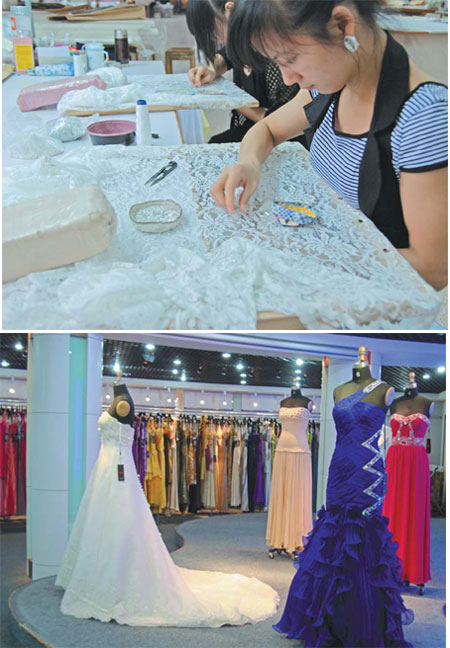
Top: A worker at the Golden Cattleya factory in Chaozhou; Above: The show room of Golden Cattleya. Photos Provided to China Daily |
Local companies have proved they are more than a production hub
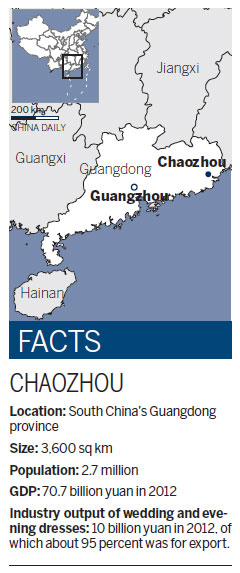
For more than two decades, Chaozhou has been the production hub of wedding and evening dresses for many international clothing retailers. Names like Vera Wang, David's Bridal and Mon Cheri from the United States and Barcelona's Pronovias called upon Chaozhou's 500 dress manufacturers to pump out elegant fashion.
Then the 2008 global financial crisis struck and things changed for the city of 2.7 million in eastern Guangdong province.
|
||||


"Before the crisis, our profit margin was about 20 percent, but now, it's even less than 10 percent," says Zhili Beading and Embroidery Co Ltd President Xie Lizhi, who adds that some companies in the city have also lowered prices to attract customers.
But years after the economic collapse created drops in profits, the city's dress producers in the city are striking it out on their own. Many are beginning to create their own brands - such as Golden Cattleya and Katrina Sposa - while forming their own design teams and investing in marketing to return to their profit-making ways.
According to the Chaozhou Economic and Information Bureau, Chaozhou companies produced more than 20 million evening and wedding dresses, earning more than 10 billion yuan ($1.61 billion; 1.23 billion euros) in revenue. Despite the high figure, Lu Weiqing, chairman of the Chaozhou Garment Association, says the city's exports have taken a hit from the 2008 crisis, down to a 10-percent growth from a high of 20 to 30 percent pre-collapse.
Companies in Chaozhou, which make more than half of China's wedding and evening dresses that are shipped overseas, took an indirect course toward making dresses. In the 1980s, Chaozhou people who lived in Hong Kong and Macao brought materials and cloth samples back home to local embroidery companies to make customized dresses. In the 1990s, these dress producers, with the help of overseas Chaozhou customers and opportunities to showcase their wares at the China Import and Export Fair in Guangzhou, the provincial capital, gradually established connections with clothing retailers in Europe and the US.
"The specialty of Chaozhou-made dresses lies in the combination of exquisite local embroidery with modern style. Unique techniques such as pad stitching, beading and weaving of Chao embroidery have made the dresses popular," says Lin Xiaoqun, head of the Chaozhou Economic and Information Bureau.
Paolo De Vitis, president of the Italian clothing retailer Fralex Srl, has worked with Chaozhou-based Jili Arts & Crafts Co Ltd to manufacture dresses for about three years.
"They have good standard quality dresses and a good reputation," he says of Jili Arts & Crafts. "Their goods respect our 'moods' and although we generally use our own designs, we appreciate their designs, too."
Chen Guohui, president of Jili Arts & Crafts, says before the recession hit Europe, its key market, the company's export value reached about $30 million in its best year. Last year, however, it made only about $20 million. The company staff was also whittled down from 600 to about 400.
Prior to the global economic crisis, Chen says, overseas orders for nearly every company in Chaozhou grew. No one, he adds, thought seriously about factors that might affect the industry's development over the long run.
"An industry's development needs supporting facilities, but we don't have a complete industry chain here. We have to buy materials from cities that are thousands of miles away, such as Suzhou in Jiangsu (province) and Yiwu in Zhejiang (province)," Chen says.
Five years after the crisis, dress producers in the city are not necessarily turning away from the global market, but they are placing the emerging domestic market at a higher priority. With their new direction, many are looking to change the way they do business, with an emphasis on internal design teams and brand-building divisions.
"While trying to stabilize their growth in developed markets, (Chaozhou companies) have also started to dip their toes in the Chinese market, as buying wedding and evening dress has started to become a big trend in China," says Lin Xiaoqun, head of the Chaozhou Economic and Information Bureau.
Tang Daolin, general manager of Golden Cattleya, whose export value reached $75 million last year, says Chinese companies will see great domestic competition. "People know that we are the manufacturers for many international big brands, so it is easier to compete with them in the Chinese market because Chaozhou's products are cheaper and have a good reputation already."
One obstacle many companies in the wedding and evening dress industry in Chaozhou faced was the fact that many were unloading their products to overseas retailers. Many did not entertain the idea of introducing their own brands because their products were sold overseas under the names of other brands.
Guangdong Jinchao Group Co Ltd, for example, is one of the biggest companies in the evening dress industry. It makes more than 90 percent of their products for overseas brands.
"It's very difficult for our (own) brands to reach Western customers because we don't have the sales channels and it's really expensive to do promotion," says Liu Sirong, chairman of the Guangdong Jinchao Group Co Ltd.
Despite that, Tang says Chinese dress producers have greatly improved recently. Companies accustomed to making products according to the designs sent over by clients are now employing their own design teams. For example, Golden Cattleya has a design team of about 30 designers. Clients, Tang says, often pick the company's designs directly.
Jili, on the other hand, is finding success with its brand Katrina Sposa, which made its debut last year and sells its dresses from 3,000 yuan to 20,000 yuan, mostly to Chinese customers.
Lu Weiqing, chairman of the Chaozhou Garment Association and president of Chaozhou Lu Classic Garments Co Ltd, says his company has established two teams, one that specializes on the overseas market and another that focuses on domestic retail. "We'll use the income from the overseas market to support the cultivation of our brands in China," he says.
Lu says most companies are still testing the domestic market. Compared with Western customers, Chinese customers might have a different appreciation of many aspects of a dress, such as the design, color and choice of material.
"For Western markets, we take orders from clients, so there are zero inventories. But for the domestic market, we need to design, produce and sell all by ourselves, so we should be careful," he says.
Although all of the work is done in-house, Lu says it's still easier for companies to create an awareness for a brand in the domestic market.
"Chinese people used to rent wedding dresses, but recently, with spending ability growing, more and more people have started to buy dresses. I think that the domestic market will see great development in three to five years," he says.
Still, other challenges exist for the industry.
"The appreciation of the yuan and the rising material and labor costs have made it difficult. Meanwhile, the Western markets' demand is decreasing, which makes it hard for companies to raise prices," Lu says.
Liu, from Guangdong Jinchao, says labor costs have increased by 20 percent and raw material costs have risen 12 percent over the past year. He says the embroidery work his company does is by hand, but his most experienced workers are older than 40 and it's been very difficult for his company to hire qualified workers.
Lu says that many companies are working hard to improve internal management to reduce their costs. He says in previous years, hardly a company cared about which or how much material should be used for one dress. Many offered the best materials to foreign customers.
"Now many have downgraded their requirements. Before 2005, about 70 to 80 percent of our dresses were made with real silk, but now, about 95 percent are made of chemical fiber, while only 5 percent are made of real silk," Lu says.
Contact the writers through chenyingqun@chinadaily.com.cn
(China Daily 03/29/2013 page12)
 Li Na on Time cover, makes influential 100 list
 FBI releases photos of 2 Boston bombings suspects
 World's wackiest hairstyles
 Sandstorms strike Northwest China
 Never-seen photos of Madonna on display
 H7N9 outbreak linked to waterfowl migration
 Dozens feared dead in Texas plant blast
 Venezuelan court rules out manual votes counting
Most Viewed
Editor's Picks

|

|


|

|

|
|
Today's Top News
Boston bombing suspect reported cornered on boat
7.0-magnitude quake hits Sichuan
Cross-talk artist helps to spread the word
'Green' awareness levels drop in Beijing
Palace Museum spruces up
First couple on Time's list of most influential
H7N9 flu transmission studied
Trading channels 'need to broaden'
US Weekly

|
|