Cuba's grip has kept AIDS in check
Updated: 2012-05-27 07:57
By Donald G. Mcneil Jr. (The New York Times)
|
||||||||


|
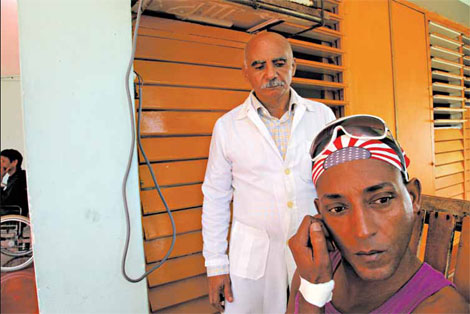
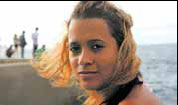
Cuba's harsh tactics kept AIDS from spreading. Juan Carlos Miranda at a sanitarium; Yudelsy Garcia O'Connor, below, was Cuba's first baby born with H.I.V. Photographs by Jose Goitia for The New York Times |
HAVANA - Cuba has one of the world's smallest AIDS epidemics. Its harsh early tactics - until 1993, everyone who tested positive for H.I.V. was forced into quarantine - has succeeded: the country now has a mere 14,038 cases. Its infection rate is 0.1 percent, on par with Finland, Singapore and Kazakhstan. That is one-sixth the rate of the United States, one-twentieth of nearby Haiti.
The population of Cuba is only slightly larger than that of New York City. In the three decades of the global AIDS epidemic, 78,763 New Yorkers have died of AIDS. Only 2,364 Cubans have.
Other elements have contributed to Cuba's success: It has free universal basic health care; it has stunningly high rates of H.I.V. testing; it saturates its population with free condoms, concentrating on high-risk groups like prostitutes; it gives its teenagers graphic safe-sex education; and it rigorously traces the sexual contacts of each person who tests positive.
Cuba has succeeded even though it has the most genetically diverse epidemic outside Africa, with 21 different strains.
And Cuba's success has come despite its being a sex tourism destination for Europeans and Canadians.
While the police enforce laws against streetwalking, bars and hotel lobbies in Havana are filled with young women known as jineteras - slang for "jockeys" - who approach foreigners with the unspoken assumption that the meeting will lead to sex. Even so, of the roughly 1,000 new infections diagnosed each year, 81 percent are among men and very few among young unmarried women.
"Most of those who sleep with tourists know to use condoms," said Dr. Ribero Wong, an AIDS specialist here.
In a survey in 2009, 77 percent of all sex workers said they regularly used condoms.
There are male jineteras for gay tourists too, of course, "but we believe the main vector is within the people," said Dr. Luis Estruch Rancano, deputy minister for public health. "Mainly, the very promiscuous group in the homosexual community who have many partners and don't take precautions."
The few Cuban women who are infected usually get the virus from partners who are secretly bisexual, experts said.
Heroin use, which drives epidemics in many countries, is virtually nonexistent in Cuba, officials insist.
And since 1986, only 38 babies have been born with the virus. In Cuba, pregnant women are tested for H.I.V. at least twice, and H.I.V.-infected women get antiretroviral drugs free.
Dr. Jorge Perez Avila is Cuba's best-known AIDS doctor. In his book, "AIDS: Confessions to a Doctor," he says it was Fidel Castro who, in 1983, galvanized Cuba's response to AIDS.
The medical establishment reacted quickly. Doctors were sent to Brazil and France to study cases. In 1986, blocked by the American embargo, Cuba bought 750,000 French test kits.
Now, all family doctors watch for infections that indicate AIDS, like Kaposi's sarcoma or Pneumocystis carinii pneumonia. Everyone who tests positive for AIDS must take a two-week course in "living responsibly with H.I.V."
With mandatory quarantine long gone and the virus now mostly in gay and bisexual men, new infections are slowly but steadily rising. They now approach 1,000 a year, "and we're waiting for the plateau," said Dr. Jose Joanes Fiol, the Health Ministry's chief epidemiologist.
The government distributes more than 100 million condoms a year. Every place with young customers, even pizzerias, is required to stock them.
"The first ones we got were from China, and had butterflies and penguins on the package," Manuel HernAndez FernAndez, an AIDS educator, said.
Cuban society is the opposite of puritanical; scanty clothing is routine, flirtation is common, and so are divorce and affairs.
Today there is more acceptance of homosexuality. At the same time, the government controls virtually all real estate, and there are no gay bars or hotels. Cruising men often have unsafe sex in abandoned buildings or parks, said LibAn Molina, 41, a volunteer at an AIDS prevention hot line.
Only about half of the 11,674 Cubans living with H.I.V. are now on antiretroviral drugs.
In theory, Cuba would be an ideal laboratory for "test and treat," the new protocol in which patients who test positive go on drugs immediately to reduce by 95 percent their chance of infecting anyone else.
However, it requires modern drugs and Cuba makes only the older, harsher ones.
Yudelsy Garcia O'Connor, the first baby known to have been born with H.I.V. in Cuba, was near death in her youth. Today she is vibrant and funny. Her father died of AIDS when she was 10, her mother when she was 23.
"I'm not afraid of death," she said. "It comes for everyone. But I take my medicine."
The New York Times
(China Daily 05/27/2012 page11)
 Relief reaches isolated village
 Rainfall poses new threats to quake-hit region
 Funerals begin for Boston bombing victims
 Quake takeaway from China's Air Force
 Obama celebrates young inventors at science fair
 Earth Day marked around the world
 Volunteer team helping students find sense of normalcy
 Ethnic groups quick to join rescue efforts
Most Viewed
Editor's Picks
|
|


|

|

|

|
Today's Top News
Health new priority for quake zone
Xi meets US top military officer
Japan's boats driven out of Diaoyu
China mulls online shopping legislation
Bird flu death toll rises to 22
Putin appoints new ambassador to China
Japanese ships blocked from Diaoyu Islands
Inspired by Guan, more Chinese pick up golf
US Weekly

|
|