Drenched New Orleans passes post-Katrina hurricane test
Updated: 2012-08-30 14:35
(Agencies)
|
||||||||


 |
|
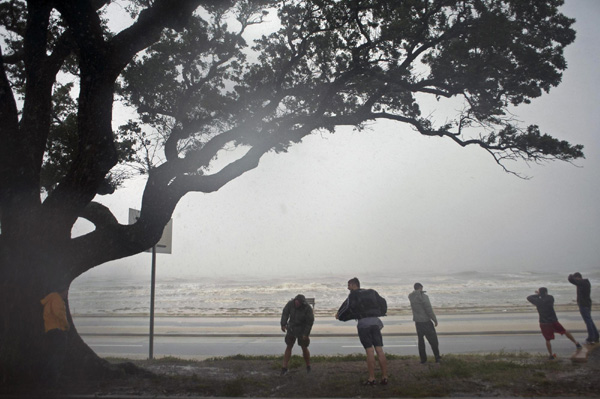
People try to get a look at the high surf along Beach Blvd as Hurricane Isaac passes through Gulfport, Mississippi, August 29, 2012. [Photo/Agencies] |
VENTURING OUT
After a night of hunkering down, some residents braved the winds and rain on Wednesday.
Walking in the French Quarter at mid-afternoon, Cameron Bradford, 24, a University of New Orleans student, was barefoot, soaking wet, and carrying a can of beer.
"Why not? This is the cleanest I've ever seen the French Quarter. The water washed everything away," he said.
Police and National Guard units, many armed with assault rifles, patrolled the virtually empty downtown area of New Orleans, a port city which normally bustles with tourists drawn to its jazz bars, Creole cuisine and French colonial architecture. They were deployed to prevent a repeat of a wave of crime that followed Hurricane Katrina.
Just four looting arrests were reported this time, but Landrieu nonetheless imposed a dusk-to-dawn curfew on New Orleans for Wednesday night.
Benjamin Hubert, 25, who works driving a mule-drawn carriage for visitors in the French Quarter, took the curfew in stride. "They just don't want people taking advantage of a bad situation, that's all," he said.
At 8 pm EST (0000 GMT) Isaac was wobbling northwestward at five mph (8 kph), producing heavy rain and significant storm surges. Sustained wind speeds dipped to 60 mph (97 kph) and it was forecast to weaken to a tropical depression by Thursday night.
An unofficial 22.5 inches (57 cm) of rain had fallen in Arabi, Louisiana, not far from the Lower Ninth Ward of New Orleans, which was swamped by Hurricane Katrina and remains partially abandoned. Audubon Park, a few miles from downtown New Orleans, had received 17 inches of rain.
Rescue efforts were concentrated in low-lying Plaquemines Parish, southeast of New Orleans. Many residents in vulnerable areas there had disregarded a mandatory evacuation order made early this week.
Emergency officials said floodwaters had flowed over an 8-foot (2.4-metre) high levee between the Braithwaite and White Ditch districts. About 118 people were rescued in Plaquemines, including 25 trapped on their roofs or attics as water rose 14 feet (4.3 meters), authorities said.
"This storm has delivered more of a punch than people thought," said Parish President Billy Nungesser. "We're not out of the woods yet."
Private citizens in their boats led the rescue effort, Nungesser said, referring to boatmen from the Mississippi Delta and bayous popularly known as the "Cajun Navy."
Jesse Shaffer, a 25-year-old Braithwaite resident, told reporters that he and his father, 53, rescued more than 20 people in several outings in their fishing boat.
In Belle Chasse, in Plaquemines Parish, canals overflowed and threatened to swamp houses, but several residents there said they planned to ride the storm despite forecasts of another 10 to 12 hours of rain.

 Relief reaches isolated village
 Rainfall poses new threats to quake-hit region
 Funerals begin for Boston bombing victims
 Quake takeaway from China's Air Force
 Obama celebrates young inventors at science fair
 Earth Day marked around the world
 Volunteer team helping students find sense of normalcy
 Ethnic groups quick to join rescue efforts
Most Viewed
Editor's Picks
|
|


|

|

|

|
Today's Top News
Health new priority for quake zone
Xi meets US top military officer
Japan's boats driven out of Diaoyu
China mulls online shopping legislation
Bird flu death toll rises to 22
Putin appoints new ambassador to China
Japanese ships blocked from Diaoyu Islands
Inspired by Guan, more Chinese pick up golf
US Weekly

|

|