Yuan boost for Christmas tree exporter
Updated: 2015-08-27 07:12
By Yan Yiqi(China Daily)
|
||||||||


 |
|
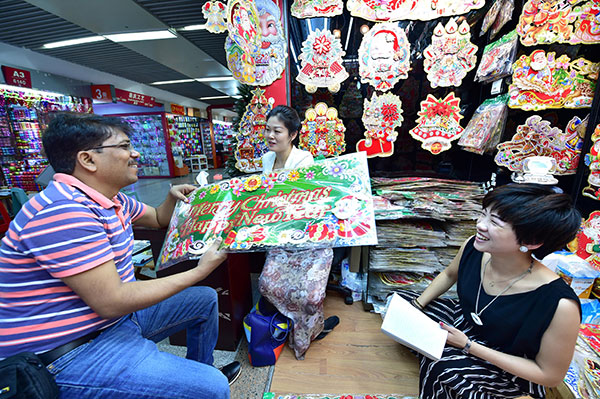
An Indian buyer talks with vendors specializing in Christmas goods in Yiwu, Zhejiang province.[Lyu Bin / China Daily] |
"Chinese garment exporters have lost their cost advantage in recent years," she said. "If we turn down customers because of the price, they will turn to factories in Southeast Asian countries such as Cambodia and Vietnam. But if we accept the price cuts, we undertake the risk of a revaluation of the yuan," she added.
In a move to cut costs and increase competitiveness, Yiwu Qijia Garment Co has started importing products from factories in other Southeast Asian countries and selling them to its foreign clients.
"Imported garments account for about 30 percent of our total sales," Wu said. "Devaluation of the yuan will definitely increase our costs in terms of imported products."
Wu's company, which is based in the eastern coastal province of Zhejiang, exports women's clothing to overseas markets that include Brazil, Japan, Europe and Russia.
"It is true that the depreciation of yuan has helped us to be more competitive in global markets, but the benefits are actually not as great as people might imagine," she said. "Our company exports garments worth about 30 million yuan a year.
"The currency change might bring only 150,000 yuan to 180,000 yuan more, and no one knows which way the yuan will go in the future," she added.
Shao Longhe, general manager of Welfull Group in Zhejiang province, shares Wu's views when it comes to China's currency fluctuations. He is not convinced the depreciation in the yuan will boost exports.
As the general manager of a State-run import and export company, Shao has 20 years experience in the business.
Welfull Group exports annually 200 million yuan of goods, including garments, textile products, bags and furniture. Most of the contracts he signed with overseas clients were fixed at the old currency rates.
"What is confusing us now is that we are about to renew our contracts for next year," Shao said. "The problem is deciding a rate and price."
While the decision to revalue the yuan has boosted confidence among Chinese exporters in labor-intensive industries, it might not turnaround slowing exports.
"Devaluation of the yuan alone cannot bring Chinese exports back to the peak periods before the financial crisis in the West in 2008, because overseas demand is weak," he added. "Most exporters in China rely on quantity to make money and that can not happen if demand keeps dropping."
- Hungary scrambles to confront migrant influx
- Turkey to hold snap parliamentary election
- Caroline Kennedy used personal email for official business
- Czech appeals for closing Schengen external border
- DPRK says inter-Korean contact gives lesson to South Korea
- Trial starts for Chinese scholar expelled from Norway

 Hairdos steal the limelight at the Beijing World Championships
 Chorus of the PLA gears up for Sept 3 parade
 Iconic Jewish cafe 'White Horse Coffee' reopens for business
 Beijing int'l book fair opens new page
 Top 10 Asia's richest tech billionaires in 2015
 Female honor guards train for military parade debut
 Floral replica of the Great Wall appears on Tian'anmen Square
 Chinese long jumpers leap to history
Most Viewed
Editor's Picks

|

|

|

|

|

|
Today's Top News
Gunman had history of workplace issues
11 under probe and 12 detained over Tianjin blasts
War anniversary: Britons born in captivity, raised in freedom
Too hard to say goodbye to Tibet: China's Jane Goodall
Two US TV journalists fatally shot on air
Smaller cub died at National Zoo
Central bank lowers lending rate to ease debts
Officials on suspended death sentence face life behind bars
US Weekly

|

|