Stamp of intent helps Chinese firms sell abroad
Updated: 2012-11-16 14:23
By Yan Yiqi (China Daily)
|
||||||||


Foreign certification firms are finding myriad opportunities to help Chinese exporters sell abroad
With less than two months to go, Sun Jianbo, general manager of Zhejiang Jinshan Textiles Co, is on a hectic mission to turn the company around before the New Year's Day. On a recent workday, Sun has his ear glued to the phone trying to call a host of foreign agencies to certify his fabric products. "Customers only recognize certificates authorized by international agencies, so although I got some (certificates) from Chinese certification companies, we still need a foreign one," he says.
|
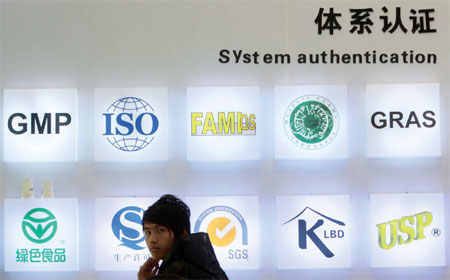 A pharmaceutical company demonstrates the quality certificates it has won at a pharmaceuticals exhibition in Nanjing, Jiangsu province. More and more Chinese companies have started to get certificates from international and local agencies to facilitate their business in overseas markets. [Photo/China Daily] |
From determining if the chemicals used in processing the fabrics are safe to ensuring the entire production process is not harmful to the environment, the requirements to secure foreign certification are moderately high for Zhejiang Jinshan Textiles, but Sun thinks it's the only way he is ever going to turn the business from a domestic producer to a far-reaching exporter. By the end of the day, Sun was working hard to finalize an agreement with a foreign agency.
With a growing number of Chinese companies selling products in Western markets, securing foreign certificates is becoming both popular and necessary for these companies, especially in light of an increasing number of export barriers against Chinese products. Essentially, if these companies want to expand their business abroad, they have to meet another country's standards for consumer safety.
|
 |
According to a report by the United Nations Conference on Trade and Development, Chinese products worth an average of $7.4 billion (5.8 billion euros) were refunded every year because of technical barriers.
Another reason why Chinese companies, from sectors such as consumer electronics to food, are more interested in procuring foreign certificates is the nation's economic slowdown. Though Chinese exports beat consensus estimates in October, overall growth this year has been sluggish. This is the main reason why Zhejiang Jinshan Textiles is redefining its business model.
But most Chinese certification agencies are not licensed to issue international certificates accepted by European or US markets. According to China's Certification and Accreditation Administration, most European countries and the US require testing results and certificates issued by agencies that they have appointed.
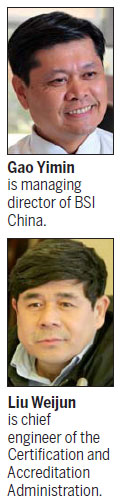
This gap has opened the door to third-party agencies, mostly foreign ones, to play an essential role in China's exporting business, says Liu Weijun, chief engineer of China's Certification and Accreditation Administration.
Liu says China has authorized business licenses to 37 foreign certification agencies and 47 testing agencies to operate in China. According to the CAA, China is now in possession of 174 certification and verification agencies, of which 58 are State-owned and 37 are foreign agencies.
"Certification and verification is like a bridge between China and the rest of the world. With increasingly higher quality demands in Western markets, facilitating certification efforts in China is important," he says.
Shentu Xianzhong, managing director of SGS China, a certification agency based in Switzerland, says that the company sees many opportunities in the Chinese market. "The Chinese market is one of the largest in the world. The global certification and verification market has a market capacity of between 700 billion yuan ($112 billion; 88 billion euros) and 1 trillion yuan," he says.
SGS entered the Chinese market as early as 1991, soon after China started to develop its certification and verification industry, which didn't become vital to the Chinese market until after China became a World Trade Organization member in 2001.
Headquartered in Beijing, SGS China has more than 40 branches, 50 testing laboratories around China and more than 10,000 employees.
Another global certification leader, UK-based BSI, also lays great stress to the Chinese market.
Gao Yimin, managing director of BSI China, says that integration into the global economy is driving Chinese enterprises to meet the standards of European and US markets in order to increase competitiveness.
BSI, which established the Chinese division in 1995, currently employs more than 260 people. It has four offices and has sales or assessor contacts across the country in 19 cities. It plans to expand to more regions over the next few years.
 Relief reaches isolated village
 Rainfall poses new threats to quake-hit region
 Funerals begin for Boston bombing victims
 Quake takeaway from China's Air Force
 Obama celebrates young inventors at science fair
 Earth Day marked around the world
 Volunteer team helping students find sense of normalcy
 Ethnic groups quick to join rescue efforts
Most Viewed
Editor's Picks
|
|


|

|

|

|
Today's Top News
Health new priority for quake zone
Xi meets US top military officer
Japan's boats driven out of Diaoyu
China mulls online shopping legislation
Bird flu death toll rises to 22
Putin appoints new ambassador to China
Japanese ships blocked from Diaoyu Islands
Inspired by Guan, more Chinese pick up golf
US Weekly

|
|