Stamp of intent helps Chinese firms sell abroad
Updated: 2012-11-16 14:23
By Yan Yiqi (China Daily)
|
||||||||


"In recent years, there have been some great developments in the Chinese verification and certification industry. Most enterprises in China have realized the importance of these certificates as part of their daily production and management," Gao says.
Liu with CAA says that after China entered the WTO in 2001, the certification market is fully open to foreign agencies, which are treated on par with domestic ones.
He says growth in China's certification and accreditation market and the increasing presence of foreign agencies have been effective in overcoming export barriers in other countries.
"With the efforts of both certification agencies and Chinese companies, Chinese products are having a bigger presence in Western markets. Certification and verification help Chinese products to build up a better 'Made in China' image," he says.
Liu says that foreign agencies appear to want more, if not complete, access to certifying domestic business. They don't want to just deal with Chinese exports, but also imports.
|
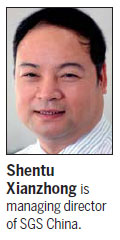 |
Shentu says State-owned certification agencies are still dominant in the niche industry, especially with China Compulsory Certifications that are used to verify the safety of imported goods.
"When people talk about foreign certification agencies, they will naturally link us to the image of dealing only with export business. The fact is, we also hope to deal with more domestic businesses, so that our business in China can reach a balanced status, which I believe won't take a very long time," says Shentu, the SGS China president.
By the end of 2011, China had issued more than 290,000 CCC certificates, according to the CAA.
Shentu says the advantage of foreign agencies lies in their global network and advanced operation and marketing experience.
"Take SGS as an example. It has a history of more than 130 years. Our long-term experience and strong global business network enables us to react rapidly to changing standards in target markets, and work out suitable solutions for our clients," he says.
BSI positions itself by providing Chinese clients with one-stop solutions, ranging from standards shaping to quality management systems training.
"All of these offerings benefit from BSI's experience as the originator of more than 30,000 different standards. Currently, eight out of the 10 most widely used international standards were originated by BSI," Gao claims.
He says BSI's advantage is that it develops standards and provides certification of these standards in the market.
One of the major problems in the Chinese market is that many Chinese companies lack the awareness of certification and verification.
"Some enterprises still have no clear awareness of standards. In addition, implementation does not always achieve 'best practice' levels, which creates a considerable gap between Chinese enterprises and those in Europe and the US," Gao says.
Sun from Zhejiang Jinshan Textiles admits that it was not until this year that his company started to realize the importance of certification.
 Relief reaches isolated village
 Rainfall poses new threats to quake-hit region
 Funerals begin for Boston bombing victims
 Quake takeaway from China's Air Force
 Obama celebrates young inventors at science fair
 Earth Day marked around the world
 Volunteer team helping students find sense of normalcy
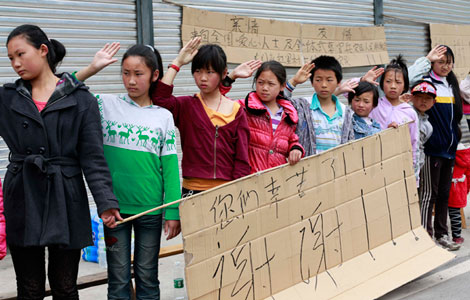 Ethnic groups quick to join rescue efforts
Most Viewed
Editor's Picks

|
|


|

|

|

|
Today's Top News
Health new priority for quake zone
Xi meets US top military officer
Japan's boats driven out of Diaoyu
China mulls online shopping legislation
Bird flu death toll rises to 22
Putin appoints new ambassador to China
Japanese ships blocked from Diaoyu Islands
Inspired by Guan, more Chinese pick up golf
US Weekly

|

|