On your mark, get set, sell
Updated: 2012-11-16 15:56
(China Daily)
|
||||||||


While multinationals used to be TUV Rheinland's major clients, Chinese companies such as Sany, XCMG, and Zoomlion have overtaken them in recent years.
Auto parts companies have become one of TUV Rheinland's key clients. Parts suppliers for Volkswagen, for instance, used to send parts to Germany for testing due to the lack of adequate facilities and accredited labs in China.
But as business has boomed, TUV Rheinland established a component testing center in Shanghai in 2011 to test auto parts supplied in China. This initiative cut the time to test parts from six months to one.
Driven by the increasing demand from Chinese companies to test products, similar organizations have popped up over the last decade.
In 2001, the China Certification and Accreditation Administration was established. Figures from the administration show there are 174 certification and accreditation entities in China, including nine from Europe and one from Hong Kong.
But TUV Rheinland has been one of the most preferred certification agencies in China. By 2011 it had more than 100,000 clients in China.
The company also has agreements with other organizations to ensure their testing results are mutually recognized. The Worldwide System for Conformity and Certification of Electrotechnical Equipment and Components CB Scheme is the world's first international system to accept test reports and certificates dealing with the safety of electrical and electronic components.
The Chinese government has also looked to TUV Rheinland to test its infrastructures. Yan says over the past few years companies in rail transportation have become a substantial business segment for the company. TUV Rheinland tests the safety and stability of tracks, transit cars as well as signal and communication systems.
TUV Rheinland also audits suppliers and franchise stores per a client's request.
For instance, its auditors pretend to be customers and "mystery shop" at clients' stores to check if products meet the company's requirements.
Yan believes that this niche has more potential in China than the traditional third-party certification services.
"Chinese companies are getting more and more standardized, so there is smaller room for a third-party audit. But we still have enormous opportunities in the second-party audit as it is more flexible and diversified," she says.
Despite the openness to auditing and testing, Yan says Chinese customers don't pay as much attention on certification as in developed countries.
She says the Chinese government should strengthen its supervision of companies and make them pay a high price if they break laws concerning consumer safety standards.
"In Germany, there are many professional magazines evaluating products from gardening machineries to automobiles and consumers will refer to these products before buying. But in China, the supervision system hasn't been established and consumers' purchases are heavily dependent on commercials," she says.
"But the Chinese government is getting more open and transparent, but it can do even better," she says.
wangchao@chinadaily.com.cn
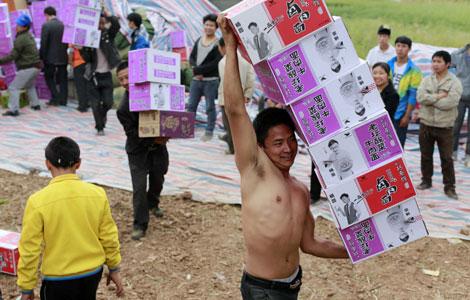
 Relief reaches isolated village
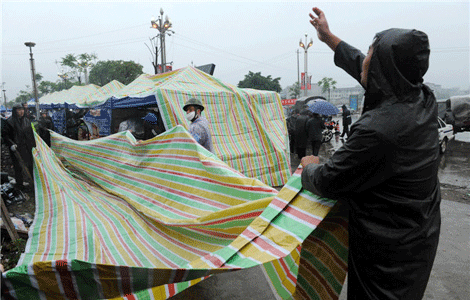 Rainfall poses new threats to quake-hit region
 Funerals begin for Boston bombing victims
 Quake takeaway from China's Air Force
 Obama celebrates young inventors at science fair
 Earth Day marked around the world
 Volunteer team helping students find sense of normalcy
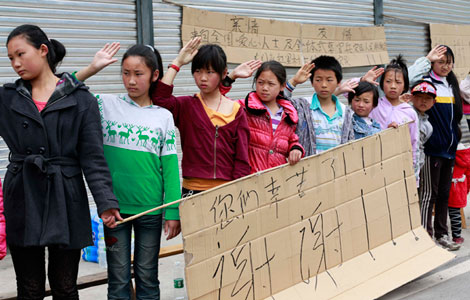 Ethnic groups quick to join rescue efforts
Most Viewed
Editor's Picks
|
|

|
|

|

|
Today's Top News
Health new priority for quake zone
Xi meets US top military officer
Japan's boats driven out of Diaoyu
China mulls online shopping legislation
Bird flu death toll rises to 22
Putin appoints new ambassador to China
Japanese ships blocked from Diaoyu Islands
Inspired by Guan, more Chinese pick up golf
US Weekly

|
|