The road to a shared future
Updated: 2015-10-02 07:48
By Oswald Chan(China Daily USA)
|
||||||||


Apps such as Uber and Airbnb have sparked both praise and controversy and illustrated how 'sharing economy' innovations are bringing 'creative destruction' to the mainstream economy. Oswald Chan examines the dynamics at play.
Steve Ng Ka-lung, senior vice- president at HKT's Product Marketing & Solutions Consulting Commercial Group, recalled how car hire app Uber made his life easier when he was visiting the United States.
"I was in the US for a business trip. A taxi ride from the airport to the hotel where I was staying cost me $80. The next day, a taxi ride from the hotel to the conference venue cost me another $40."
"After the conference, I remembered that I had earlier downloaded the Uber app on my smartphone. I activated the app again to see whether I could make use of the app to reduce my taxi fares."
Car hire app Uber operates in more than 250 cities worldwide after being launched in March 2009 and as of February was valued at $41.2 billion, according to PricewaterhouseCoopers (PwC), a market capitalization that exceeds those of US transportation giants such as Delta Airlines, American Airlines and United Continental, operators of United Airlines.
Once Ng made contact with Uber, the app arranged for a driver to take him from the conference venue back to his hotel. "Guess how much the ride was? It was just $9 - much cheaper than taking a taxi," Ng said.
"The car driver told me: 'Well, the ride from the conference venue back to your hotel corresponded to the way back to my home. It did not cost me very much to take the ride with you'," Ng recalled.
Ng's experience is a testimony to how economic resources can be "shared" for a win-win scenario, where he as a consumer got a cheap ride to his destination while the driver could make some money on his way home.
In the last few years, this "sharing economy" has made inroads into the global economic structure by challenging the dominant assumptions of the mainstream economy.
The sharing economy offers a new economic model where people rent underutilized items such as physical spaces (spare rooms, parking spaces and garages), transportation (automobiles, bikes and boats), certain infrequently used items (household items, event equipment, apparel and sporting goods) and even time and skills, allowing owners to monetize their underutilized items or skills.
At the other side of the spectrum, sharing activities provide opportunities to those who seek convenient access to physical items or skills over ownership of such possessions.
This highlights the shift from functional or conspicuous consumption (static material possessions) to experiential consumption (dynamic derivation of satisfaction and status in consumption).
Ng's experience of using accommodation search app Airbnb reveals another facet of the sharing economy.
Airbnb is an online app that helps people rent private travel accommodation from homeowners willing to offer their space to strangers. According to PwC, Airbnb accommodates more than 155 million guest stays annually, nearly 22 percent more than Hilton Worldwide, which served 127 million guests in 2014. The app is reportedly valued at $13 billion, more than mature hospitality players such as Hyatt or Wyndham Worldwide.
"I visited Sydney (Australia) for a weeklong personal trip. I decided to use the Airbnb app to see what kind of personal accommodations I could get. In an instant, I got four selection choices after utilizing the app. Efficiency is what attracted me to the app," Ng said in recounting his Airbnb experience.
"Then I decided to take one of the accommodations offered. Later I found out that the homeowner is a Hong Kong immigrant living in Australia for more than 20 years. He spoke fluent Cantonese and we chatted over many matters."
"At the end of the trip, the homeowner told me he could suggest outdoor activities suitable for my son if we visited Sydney again. This really impressed me. I think the sharing process can elicit more personal interactions that we both cherish."
A confluence of technological, social and economic factors explains the emergence of the sharing economy, according to a report by international research consultancy firm Latitude.
Share and share alike
The rise of Internet technology, along with the proliferation of social, mobile, analytics and cloud computing provides unprecedented easy access to items that can be potentially hired, or borrowed. Technology giants such as Amazon, eBay, Google, Apple and PayPal also play a critical role in building large-scale sharing communities and ensuring a seamless monetary transaction flow to hasten the development of the sharing economy.
Others cite environmental factors, highlighting the connection between sharing and sustainability. Sharing is better for the environment. When people exchange rather than buy, it downsizes the manufacturing processes involved in goods production, thereby reducing the depletion of natural resources in the manufacturing process.
The fragile state of the global economy over the past years has sparked heightened awareness related to purchasing decisions, stressing practicality over consumption. Lower-income households are more likely to engage in sharing behaviors because households can save money through renting.
According to a survey in July by the non-profit Hong Kong Internet Registration Corporation, nearly 30 percent of the 1,447 Internet users interviewed took part in sharing activities more than eight times a year. And a significant 82 percent were consumers of sharing economy activities, with car-sharing, crowd funding and room/flat sharing being the three top sectors.
In Hong Kong, many sharing economy-based online platforms have emerged in recent days, boosting the development of the sector.
Former research assistant Elliot Leung Wai-yu last November launched a mobile app called Gaifong, an on-demand portal for borrowing and renting consumer goods from people living nearby.
After four years of teaching and research in the fields of social sciences and sustainable development, Leung developed the conviction that people can get everything they need if they are willing to share, a realization that led to the launch of Gaifong.
Everyone's a winner
Since its launch, the mobile app's registered member base has grown 10 times to 4,000 members in Hong Kong, with some 2,000 consumer items already shared. Bouyed by its success, Gaifong is thinking of soliciting angel investors for funding in the near future.
Lenders determine the rent level, and Gaifong deducts a day's rent as commission charge upon successful rental.
Borrowers are also required to pay a cash deposit equal to 50 percent of the goods value as a safeguard against unforeseen damages.
"Our business values are different from the mainstream consumer culture and therefore we need to do a lot to change the culture. We also have to leverage on existing trust profiles on various social media to build online community trust so that our services can make inroads into the mainstream economy," Leung said.
WeCare, a student service group that promotes social inclusion in Hong Kong focusing on domestic workers and ethnic minorities, borrowed cameras through Gaifong to make a photography course possible. That was after 20 enthusiasts signed up for the course, but not all could buy or borrow professional cameras.
Though the Gaifong mobile app, WeCare could lend them professional cameras. Even some camera-owners who had originally posted for rental deals ultimately lent those cameras to WeCare for free once they came to know that WeCare was a charity organization.
"I think both the users and owners benefit from this process. People often have something they do not always use - in this case the cameras - but these could be very useful to others and contribute to a greater cause," said Lucia Liu Yujing, communications officer at WeCare.
Carshare.hk, a startup aiming to facilitate car hiring from fellow citizens, has connected 1,500 car owners and 18,000 renters since its launch in November 2013. Their mobile app claims to facilitate more than 1,000 car rentals a month for HK$400 to HK$500 per day, and charges 30 percent commission on each rental deal.
After collecting HK$5 million from angel investors, the app launched in Shanghai last year. The company is considering venturing into Taiwan and Southeast Asian nations for scaling up the business. Carshare.hk has also arranged a comprehensive insurance policy (involving the renter, the car and any third party damages) with DirectAsia that especially covers any incident during the rental period. The company requires car owners to install a device to calculate the mileage for insurance purposes.
Renters have to pay fuel charges and the insurance premium apart from the hiring price. As for car-owners, they have to pay HK$750 as device installation charges and they will receive 70 percent of the rental price, the rest going to Carshare.hk.
"As there are several occasions when I do not drive my car for extended periods of time, sharing is a pretty good idea to fully utilize my asset. Carshare gives me peace of mind, as I do not think sharing a car is appropriate before renters' background checks and insurance are settled," said Kinsen, a Toyota Picnic Deluxe owner who listed on the app.
But what if car-owners and hirers utilize their eventual familiarity to bypass the app and create their own sharing arrangements?
"We are not afraid that car owners and renters will bypass Carshare when they become familiar with each other. This is because the automobile insurance from DirectAsia will not cover accidents under just any rental deal agreed between car-owners and renters," Carshare.hk co-founder Joyce Kan Suet-yan said.
The rise of apps in goods sharing is pushing intermediaries to become more efficient by making timely market responses and bringing value-added services, Kan added.
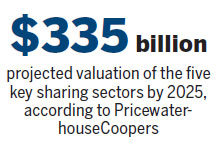
PwC projects that the five key sharing sectors - travel accommodation, cars, finance, staffing, and music and video streaming - will see potential global revenues skyrocket over the next decade, from roughly $15 billion today to around $335 billion by 2025.
Contact the writer at oswald@chinadailyhk.com

|
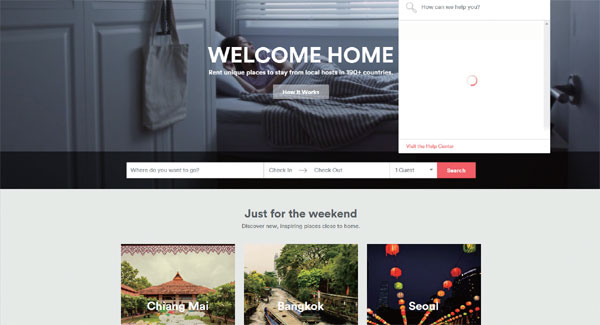
Airbnb, which features some 3,000 Hong Kong homestay options, may actually be breaching the SAR's ordinance on running hotels and guesthouses. |
(China Daily USA 10/02/2015 page6)
- Senior US envoy to visit Japan, S Korea, China
- Russia, US agree to cooperate in solving Syria crisis: Russian FM
- Iranian President calls Iran deal victory over war
- LatAm experts praise Xi on yuan, globalization
- Evidence found of summertime water flows on Mars: study
- Dogs surf in contest in California
 Ten highlights from Xi's trip to US and UN
 Top 10 life-changing benefits from Xi's US visit
-
Highlights of President Xi's speeches at UN
-
The president's historic journey to the west
-
China's first lady visits Juilliard School
 Polish couple brings six daughters to China to study Chinese
 Top 10 nominated designs at Beijing Design Week
-
China gifts the UN 'Zun of Peace' for 70th anniversary
Most Viewed
Editor's Picks

|

|


|

|

|

|
Today's Top News
Xi pledges $2 billion to help developing countries
Young people from US look forward to Xi's state visit: Survey
US to accept more refugees than planned
Li calls on State-owned firms to tap more global markets
Apple's iOS App Store suffers first major attack
Japan enacts new security laws to overturn postwar pacifism
Court catalogs schools' violent crimes
'Beauty of Beijing's alleys akin to a wise, old person'
US Weekly

|

|