Turned off, tuned out
Updated: 2012-06-06 09:11
By Sun Li (China Daily)
|
||||||||


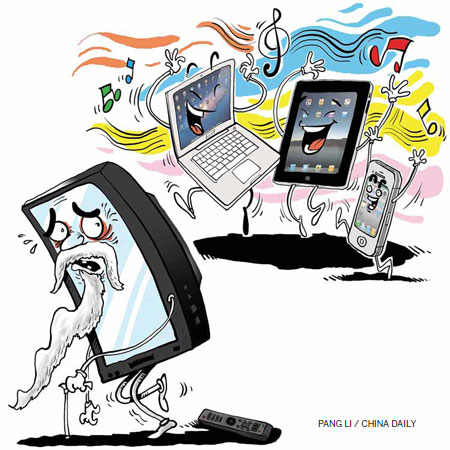
A growing number of people are swapping TV sets for computing devices. Sun Li reports in Beijing.
Television set ownership was rare in the 1980s, and today its viewership is returning to rarity as more people turn to computing devices to watch shows.
Most people who watch TV programs on traditional sets are older than 40, a recent report by the Shanghai-based iResearch Consulting Group finds. Younger people are more likely to watch them on personal computers and mobile phones.
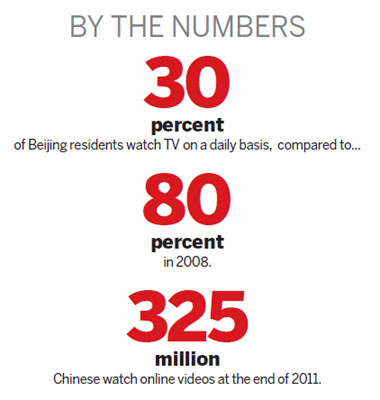
The report also shows only 30 percent of Beijing residents watch TV on a daily basis, compared to 80 percent in 2008.
Wang Lin, an IT worker at a Shanghai-based foreign-funded enterprise, says he almost never uses a television set.
"I stream videos on my smartphone when I hop on the subway. I use my tablet to follow TV shows on business trips. And I search for any program I want on my laptop at home," Wang says.
He says he felt disconnected from TV when he began university.
"There was no TV set in the dorm, but almost every student had a computer," he recalls.
"The Internet enabled us to keep up with various programs."
But the 30-year-old from Yangzhou, Jiangsu province, says he still feels nostalgia for TV.
"TV was rare in the 1980s, and only rich households had a set," he recalls.
"It was a status symbol."
He recalls his childhood excitement when kids would gather at a house with a TV set.
"Many people born in the 1980s would play outside the house on Tuesdays, because that day of the week was when TV stations nationwide would inspect and perform maintenance on their facilities," he recalls.
"All that was on TV was a circle that indicated there was no signal. I hated that circle with all my heart."
Wang saw the evolution from black-and-white to flat-screen but believes the "good old days" of TV are gone.
"I used to fight my parents for control of the remote, and they eventually bought another set so we could watch different things," he says.
"But I've virtually abandoned TV, so the sets are only used when my parents want to watch different shows, because they still watch it in their free time."
Tsinghua University's School of Journalism and Communications professor Yin Hong says the shift away from TV is inevitable with the proliferation of smartphones and Internet access in metropolises.
"These devices are far more portable than the bulky TV sets," he says.
"They better suit young urbanites, who are accustomed to fast-paced lives. And while the TV set only sends information one way, online videos offer interactivity, because people can leave comments and join online discussions."
Liu Chun, head of the video channel of Sohu.com, one of the country's largest Internet portals, believes content quality is also causing youth to shift toward newer devices.
In recent years, Internet portals have bought up a slew of domestic and foreign TV series, in addition to generating their own content, Liu says.
The number of online video users in China reached 325 million at the end of 2011, accounting for 63.4 percent of the nation's total number of Internet users, the China Internet Network Information Center reports.
Chen Gang, an accountant with a State-owned company in Jiangsu province's capital Nanjing, considers himself a devout online video consumer.
"Television is awash with mindless junk nowadays," Chen says.
"Talent shows and serials are copying one another. They are presenting repetitive stupidity and ridiculousness. Why watch?"
The 26-year-old says he enjoys US TV series and Taiwan variety shows, which aren't aired by TV stations.
"Even if I want to watch some popular domestic shows, I won't turn on my TV, because I don't like the commercials," Chen says.
"You don't have to worry about that online."
Zhang Yizhe, a Web editor in Beijing, says: "I haven't moved my TV from its prominent location in my living room, but its prominence in my life is fading."
About the only times he uses his TV are when watching soccer or a DVD.
"There are sometimes a few seconds of delay when you watch sports online," the 27-year-old explains.
"And computer screens aren't good for watching blockbusters. It's only in those cases that TV comes to my rescue."
But while the classic couch potato will become a rarer species, it won't become extinct despite the growing predominance of Internet and mobile devices, Tsinghua University's Yin says.
People in rural areas are more likely to watch TV on traditional sets, Beijing-based television ratings analysis company CSM Media Research reports.
"High-speed Internet access may be limited in some rural areas, and people there may still depend on the television for entertainment. So will elderly people, who don't adapt to new media," Yin says.
"But for others, TV is increasingly becoming less of an appliance and more like a piece of furniture."
Contact the writer at sunli@chinadaily.com.cn.

 'Taken 2' grabs movie box office crown
 Rihanna's 'Diamonds' tops UK pop chart
 Fans get look at vintage Rolling Stones
 Celebrities attend Power of Women event
 Ang Lee breaks 'every rule' to make unlikely new Life of Pi film
 Rihanna almost thrown out of nightclub
 'Dark Knight' wins weekend box office
 'Total Recall' stars gather in Beverly Hills
Most Viewed
Editor's Picks

|

|


|

|

|

|
Today's Top News
Health new priority for quake zone
Xi meets US top military officer
Japan's boats driven out of Diaoyu
China mulls online shopping legislation
Bird flu death toll rises to 22
Putin appoints new ambassador to China
Japanese ships blocked from Diaoyu Islands
Inspired by Guan, more Chinese pick up golf
US Weekly

|

|