Don't want you under my skin
Updated: 2012-08-08 10:23
By Liu Zhihua (China Daily)
|
||||||||


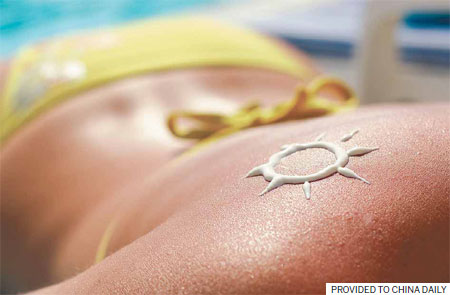
Skin cancer is on the rise in China and experts say this is because most people do not know how to protect themselves properly from too much sun. Liu Zhihua finds out the details.
Experts are saying they are seeing more skin cancer among Chinese, and they warn that this deadly form of carcinoma is likely to increase. They say people are going the wrong way about protecting themselves from exposure to strong sunshine. And that a little sun can actually be good for you.
Although there are no national surveys as yet, numbers in Beijing and Shanghai show that the incidence rate of melanoma is five times higher than it was five years ago, according to Guo Jun, chairman of Society for Melanoma Research in Asia and Pacific Area, and vice-president of Beijing Cancer Hospital.
That means one out of every 100,000 people in these two cities have the skin cancer.
Dermatologists are also seeing more patients with these symptoms, says Tu Ping, a famous skin cancer specialist at the Peking University No 1 Hospital.
"Among the possible factors contributing to skin cancers, sun damage is the prime cause, and it is a cumulative effect," Tu says. He sees about 600 skin cancer patients a year on average.
"Some people are not aware of the importance of sun safety, and some others try to block out sunlight as much as possible. Both approaches are wrong," Tu says.
All cancers are caused by DNA mutations, which can be inherited, but in most cases, are built up over a person's lifetime by environmental factors.
Ultraviolet rays, mostly, ultraviolet-B in sunlight, is responsible for DNA mutation in skin cancers, Tu explains.
"People think they should avoid getting tanned, when they think of sun protection. That's not correct," says Guo Jun, the melanoma specialist.
"Repeated overexposure to sunlight will lead to skin irritations, such as allergies and blisters. But, there is a more dangerous effect - it may trigger skin cancers," Guo says.
When too much sun damages skin cells, the human body will try to repair them. In the process, DNA mutations and abnormal growth may happen, Guo says.
Different skin cancers result when various types of skin cells are affected. The good news is: Unlike other cancers, most skin cancers, such as basal cell carcinoma, can be treated, although the treatment can be disfiguring.
Melanoma is actually easy to treat if diagnosed early. However, it is usually not noticeable at the beginning, and without treatment, it can spread quickly throughout the body, and become life threatening.
"People have been wearing less and less in past decades, and they travel more and participate in outdoor sports more as well," Guo says. "These factors may also contribute to the rising rates of skin cancers."
It takes years or decades to develop skin cancers, but each time, sunburn increases the possibilities, he adds.
"Most of my skin cancer patients are over 40, and they cared little about sun safety in their younger days," Tu, the dermatologist, says.
"Nowadays, ordinary people, especially young people, are more aware of their appearance and getting protection from the sun, but they sometimes go overboard."

 'Taken 2' grabs movie box office crown
 Rihanna's 'Diamonds' tops UK pop chart
 Fans get look at vintage Rolling Stones
 Celebrities attend Power of Women event
 Ang Lee breaks 'every rule' to make unlikely new Life of Pi film
 Rihanna almost thrown out of nightclub
 'Dark Knight' wins weekend box office
 'Total Recall' stars gather in Beverly Hills
Most Viewed
Editor's Picks

|

|


|

|

|

|
Today's Top News
Health new priority for quake zone
Xi meets US top military officer
Japan's boats driven out of Diaoyu
China mulls online shopping legislation
Bird flu death toll rises to 22
Putin appoints new ambassador to China
Japanese ships blocked from Diaoyu Islands
Inspired by Guan, more Chinese pick up golf
US Weekly

|

|