Essential elements
Updated: 2012-08-10 09:31
By Chen Nan (China Daily)
|
||||||||


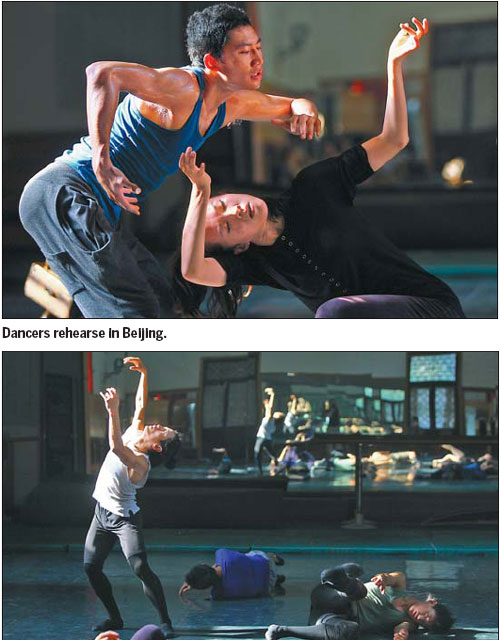
The choreographer also invited Tibetan eagle flute players to perform. The flute is made from the wing bones of eagles.
The choreographer first had the idea for Shambhala when he studied at Minzu University in 2000, to express his love for Tibetan culture and his pursuit of freedom.
"I hate being constrained by restrictions. That's why I quit from a stable job at a national dance troupe after graduation. It was like setting free a bird from a cage," he says. "My dance works were all from my roots - Tibetan culture. Shambhala is a landmark in my career."
Wanma Jiancuo's name means "sea of wisdom" in the Tibetan language, and was conferred by his father, who was the director of Song and Dance Troupe of Hainan Tibetan Autonomous Prefecture and the only choreographer in the troupe then.
His father hoped he will carry on his career. However, Wanma Jiancuo says that it was not love at first sight with dance.
Running with friends among mountains and grasslands, he had a happy and close-to-nature childhood.
His father sent him to a kung fu class at Minzu University of China, at age 12. However, when he enrolled he realized that kung fu was just one part of the classes and most courses were about dancing.
Though reluctant and unhappy, he studied there for six years and entered the folk dance department of the university.
"You know, I learned various dance genres, such as ballet, folk dance and modern dance, and the influences were unconscious," he says. "Dancing is like my second language."
"I appreciate his resilient spirit as a Tibetan dancer. He is pioneering and really found his role, the reasons and significance of his work and that's truly amazing for independent dancers in China now," says Tanzhou Dorje, a 56-year-old folk dance professor at the university for 30 years, who taught Wanma Jiancuo and considered him one of his best students.
In 2003, Wanma Jiancuo founded his dance studio, Beijing City Shepherd Studio, together with four like-minded friends. Like many independent artists, besides choreographing dances for the studio, they also made shows for companies and governmental events to make ends meet.
In 2011, Wanma Jiancuo stayed in Yunnan province for several months to create a dance show for a tourism company.
"Those dances require interaction with the audiences. Dancers would step off stage and communicate with audiences through their dancing. However, what I want in my own work is not like that," he says.
"Dancers and audiences are equal. I don't want the dancers to serve the audiences. I want something abstract, leaving a space for the audiences to think and imagine."
As a veteran dancer and choreographer, he has another crucial mission - cultivating young Tibetan dancers, who will carry on his ideas.
Laba Zaxi, a 21-year-old Tibetan dancer, won a gold award at Seoul International Dance Competition 2012 for his performance in Silent Marnyi Stone, a dance work choreographed by Wanma Jiancuo.
"He can barely speak Mandarin but when he dances, you can feel what he wants to say," Wanma Jiancuo says. "I am glad that the young Tibetan generation is passionate about its culture. Though urbanization and globalization influence them and they wear hip-hop clothes and dye their hair, they still reserve a respectful place in their hearts for Tibetan culture."

 'Taken 2' grabs movie box office crown
 Rihanna's 'Diamonds' tops UK pop chart
 Fans get look at vintage Rolling Stones
 Celebrities attend Power of Women event
 Ang Lee breaks 'every rule' to make unlikely new Life of Pi film
 Rihanna almost thrown out of nightclub
 'Dark Knight' wins weekend box office
 'Total Recall' stars gather in Beverly Hills
Most Viewed
Editor's Picks
|
|

|

|

|

|
Today's Top News
Health new priority for quake zone
Xi meets US top military officer
Japan's boats driven out of Diaoyu
China mulls online shopping legislation
Bird flu death toll rises to 22
Putin appoints new ambassador to China
Japanese ships blocked from Diaoyu Islands
Inspired by Guan, more Chinese pick up golf
US Weekly

|

|