Zoos ask: Now what?
Updated: 2012-08-20 13:35
By Leslie Kaufman (The New York Times)
|
||||||||


 |
|
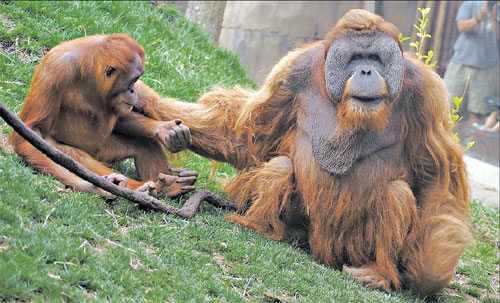
Controlling breeding at zoos presents few options. Orangutans at the Saint Louis Zoo get birth control. In Europe, euthansia is more prevalent. Carol Weerts / Saint Louis Zoo |
The choices are difficult when babies don't fit plan
Zookeepers around the world, facing limited capacity and pressure to maintain diverse and vibrant collections of endangered species, are often choosing between two controversial population limits: birth control and euthanasia.
In the United States, the choice is contraception. Chimps take human birth control pills, giraffes are served hormones in their feed, and grizzly bears have slow-releasing hormones implanted in their forelegs. Even small rodents are included.
Cheryl Asa, who directs the Association of Zoos and Aquariums' Wildlife Contraception Center at the Saint Louis Zoo, said euthanasia was not a comfortable fit. "On an emotional level, I can't imagine doing it and I can't imagine our culture accepting it," she said.
Dr. Asa sees contraception as a better approach. "By preventing the birth of animals beyond carrying capacity," she said, "more animals can be well cared for."
But in Europe, some zookeepers would rather euthanize unneeded offspring after they mature than deny the animal parents the experience of procreating and nurturing their young.
"We have already taken away their predatory and antipredatory behaviors," said Bengt Holst, director of conservation for the Copenhagen Zoo. "If we take away their parenting behavior, they have not much left."
So he and many of his European counterparts generally allow animals to raise their young until an age at which they would naturally separate from parents. It is then that zoo officials euthanize offspring that do not figure in breeding plans.
This spring, the Copenhagen Zoo put down, by lethal injection, two leopard cubs, about 2 years old, whose genes were already overrepresented in the collective zoo population. Leopards are considered near threatened by the International Union for the Conservation of Nature. But as part of a breeding plan to maintain the genetic diversity of this species, the cubs' fate was determined before they were born.
The Copenhagen Zoo, Mr. Holst said, annually puts to death some 20 to 30 healthy exotic animals - gazelles, hippopotamuses, and on rare occasions even chimps.

 'Taken 2' grabs movie box office crown
 Rihanna's 'Diamonds' tops UK pop chart
 Fans get look at vintage Rolling Stones
 Celebrities attend Power of Women event
 Ang Lee breaks 'every rule' to make unlikely new Life of Pi film
 Rihanna almost thrown out of nightclub
 'Dark Knight' wins weekend box office
 'Total Recall' stars gather in Beverly Hills
Most Viewed
Editor's Picks

|

|


|

|

|

|
Today's Top News
Health new priority for quake zone
Xi meets US top military officer
Japan's boats driven out of Diaoyu
China mulls online shopping legislation
Bird flu death toll rises to 22
Putin appoints new ambassador to China
Japanese ships blocked from Diaoyu Islands
Inspired by Guan, more Chinese pick up golf
US Weekly

|
|