Organically Yours
Updated: 2012-05-25 09:05
By Li Aoxue (China Daily)
|
||||||||


|
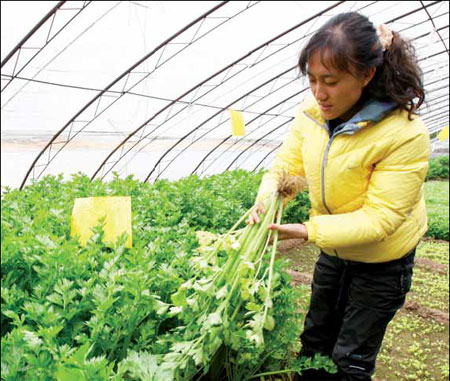
Shi Yan picks celery in her organic farm in Beijing, which is considered to be the country's first. Zhu Xingxin / China Daily |
Young woman farmer pioneers community-based food markets for producers and consumers
While many Chinese graduates flocked to the United States to attend universities in 2008, Shi Yan went to a farm instead.
Shi, a postgraduate in rural development at Renmin University of China, spent six months in the Midwest state of Minnesota learning all about community-supported agriculture. When she came back, she founded Little Donkey Farm, which is considered to be China's first CSA farm, and promoted the concept of growing organic food to the nation.
Shi was the first PhD to be funded by the government to learn the skills and techniques of operating a CSA farm.
CSA's origins can be traced back to the 1970s in Japan and Switzerland, where customers would pay farmers for fruits and vegetables in advance, and farmers would home-deliver orders once harvesting began.
"It is sustainable, energy-saving, and reduces the distance between consumers and farmers," Shi says.
The major model for agriculture and food distribution worldwide nowadays has stretched the distance between consumers and farmers. Shi says that vegetables sold in Minnesota, for example, could be from California, while Minnesota's vegetables could be sent to California, and because many third parties are involved, food safety can be compromised.
"Within the CSA model, consumers know the food producers, and this increases the trust between them and better ensures food safety," Shi says.
Little Donkey Farm was set up in 2009 in the outskirt of Beijing, but Shi says recognition of CSA in China is behind that in other countries, such as in the US and Japan.
"CSA has been recognized in the US since 2008, and if you talk with local people there, they all know what CSA is. But in China, few people are aware of it," Shi says.
However, Shi and her team have built up China's first CSA network and have held annual meetings since 2009. About 500 people attended the 2011 meeting.
Shi and her colleagues produce brochures and give lectures on the benefits of organic food availability in neighborhoods. And together with the 30 farmers who work for Little Donkey Farm, there are about 20 interns who Shi hopes can be turned into CSA experts to promote the system.
Little Donkey has about 600 orders for organic produce from households in Beijing each year.
"Most people eat organic food because of its taste and nutritional value, but very few realize that other qualities and benefits, such as the caring, fair and environmentally friendly nature of the system, which are the most valuable things to consider when choosing to eat it," Shi says.
Producing organic food does not involve the use of synthetic pesticides and chemical fertilizers. In China, promoting organic food is especially important because farmers find it difficult to avoid using chemical fertilizers to protect their crops from harm.
"Most Chinese farmers do not wear a mask during chemical fertilizer spraying, and this adds to the risk of getting cancer," Shi says.
After Little Donkey Farm was set up, Shi says thousands took an interest in CSA and visited Beijing to learn about the system.
Shi says 80 percent of them went on to operate CSA farms in their own region, and with the expansion of the middle class in China, some started to look at investing in the organic food industry.
"I don't fear market competition. Rather, I want more people in China to know about the benefits of organic food and CSA," Shi says.
At Changzhou, in Jiangsu province, Shi's husband runs Big Buffalo, a CSA farm similar to Little Donkey. And in Fuzhou, Fujian province, another CSA is planned as an expansion of Little Donkey's operations.
Also, this summer, a CSA farm is starting up in a village near Shi's farm.
Produce from Little Donkey is much cheaper than that from other sources in China. Vegetables sold at the supermarket for about 20 yuan ($3, 2.5 euros) per kilo cost only 8 yuan per kilo at Shi's farm.
"I want to make organic food affordable to more customers, and let them know the benefits of it," Shi says.
While Shi was a child, she was always fascinated by stories of her parents' rural life in Baoding, Hebei province.
"I remember my father putting on films for the local people and my mother was a women's team leader for farm work, and what they did sounds very interesting to me, because I grew up in the city," Shi says.
Influenced by her parents' rural life from an early age, Shi chose to study management of agricultural economy for her undergraduate degree at the Agriculture University of Hebei in 2004. In 2008, she completed her PhD degree in rural development and went to the US to experience farm life and work for the first time.
Since then, she has also completed a post-doctorate course in humanities and social sciences at Tsinghua University.
"My time in the US was totally different from what I am doing now. I may have felt physically tired after a whole day's work there, but now I have added mental work, such as how to furnish a canteen for the farmers at my farm, produce brochures for my customers, and so on," says 30-year-old Shi.
However, she says she loves her work and working in a natural environment.
"When you feel tired or have a headache, you become more relaxed if you just take a look around at the scenery," Shi says.
In her spare time, Shi likes reading, and has started to take an interest in books on traditional folk houses.
"Only folk homes can represent the multicultural nature of a country, as nowadays the structure of every city looks the same. But from the houses of each group of country people, you can experience different cultures, foods and languages," Shi says.
Shi is now busy with spring sowing.
"Working in the country is different from working in the city. Here in the countryside, everything is normal, and you will not experience the ups and downs that you have to in the city. What country life brings you is happiness," Shi says.
liaoxue@chinadaily.com.cn
(China Daily 05/25/2012 page21)
 Relief reaches isolated village
 Rainfall poses new threats to quake-hit region
 Funerals begin for Boston bombing victims
 Quake takeaway from China's Air Force
 Obama celebrates young inventors at science fair
 Earth Day marked around the world
 Volunteer team helping students find sense of normalcy
 Ethnic groups quick to join rescue efforts
Most Viewed
Editor's Picks

|

|


|

|

|

|
Today's Top News
Chinese fleet drives out Japan's boats from Diaoyu
Health new priority for quake zone
Inspired by Guan, more Chinese pick up golf
Russia criticizes US reports on human rights
China, ROK criticize visits to shrine
Sino-US shared interests emphasized
China 'aims to share its dream with world'
Chinese president appoints 5 new ambassadors
US Weekly

|

|