A duck to water
Updated: 2012-08-03 07:57
By Mark Graham (China Daily)
|
||||||||


|
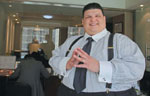
For Paul Hsu, happiness is "a whole restaurant full of people". Mark Graham / For China Daily |
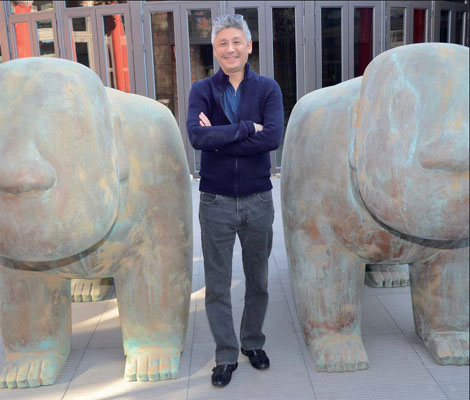
Restaurateur takes iconic Beijing dish to new heights
Paul Hsu has built up a diverse portfolio of restaurants in three Chinese cities serving food from Italy, Vietnam, Japan and different regions of China, a business that generates about $40 million in revenue annually.
The Hong Kong-born American restaurateur prides himself on having well-developed antenna for just what the market needs, best demonstrated by the decision to open a fine-dining Peking duck restaurant in Beijing. Many people thought the capital was already well served by restaurants serving the iconic dish, but Hsu was convinced there was a need for a restaurant with classy decor, a fine-wine list and top-notch, Hong Kong-style service.
His instincts proved to be correct. Duck de Chine, located in a gentrified former electronics factory compound close to the nightlife zone of Sanlitun, was a hit from day one. Recently, Hsu opened a second outlet of the restaurant, this time in a purpose-built, imperial style complex. 19492-Jin Bao Jie has spacious courtyards with specially commissioned sculptures, art and photography on the walls, 11 private dining rooms and, most importantly, three generous sized, wood-fired ovens for roasting ducks.
Rather cheekily, Hsu decided to add a Cantonese element to the serving of the duck: the herb-infused hoi sin sauce, mixed with peanuts, garlic or sesame, has proved to be hugely popular. Another break with tradition is to have a champagne bar in both Peking duck restaurants, so guests can have a pre-dinner glass of bubbly, or a cocktail, an unheard-of fixture in traditional Chinese dining outlets.
"Before we opened, I tried every single Peking duck restaurant in Beijing. I did the whole book; it was a fascinating experience to understand the personality of every operator," he says.
"Peking duck is an iconic Beijing thing. I think we have refined and improved it. Sometimes it takes an outsider to look at something from a different angle.
"You can only really do it properly in Beijing with the ducks that are available here and the special wood. The wood makes the difference. It is date wood, from trees that are 40 years old. The ducks are a bit larger than normal as we buy the biggest around, weighing about 2 kilograms. We roast them for longer than the standard 65 minutes, to achieve extra tenderness."
There is little that Hsu does not know about the hospitality business after more than 30 years working in hotels, restaurants and bars. The father of two grown-up children graduated from the Cornell School of Hotel Administration in the United States more than three decades ago and later worked in two of the Chinese mainland's first luxury hotels, the White Swan in Guangzhou and the Shanghai Hilton.
A move back to Hong Kong saw the founding of Elite Concepts, a group that opened chic restaurants, often in run-down areas that were about to undergo gentrification, the best-known being Lan Kwai Fong in Central, now the prime nightlife zone of the city, Star Street in Wan Chai and Knutsford Terrace in Tsim Sha Tsui. The cuisine included French, Italian, American, Japanese, Vietnamese and regional Chinese.
A restaurant that updated Shanghainese cuisine, Ye Shanghai, proved to be so popular in Hong Kong that Hsu took the concept to the mainland port city, opening a branch in the then new lifestyle zone of Xintiandi in a siheyuan, a converted traditional home.
That was followed four years ago by 1949, the Hidden City, in a tucked-away former Beijing factory compound close to Sanlitun featuring seven restaurants and bars and the flagship Duck de Chine.
It quickly became a must-visit spot for discerning Beijing diners, who were able to feast on the city's most famous dish without enduring the so-so decor and hubbub found at more mass-market restaurants. Among the recent visitors were the double Oscar winner Kevin Spacey, in town to perform Richard III, and the famously meat-loving editor of American Vogue, Anna Wintour.
"We were turning people away every night at Duck de Chine and, because of the way Beijing is set up, you can operate at multiple locations without affecting business, so we decided to open a second outlet," Hsu says. The addition of the restaurants in China has helped take the Elite Concepts group annual turnover above $40 million, making it one of the significant regional independent industry players; the two Beijing operations alone employ 500 people.
Two recently added restaurants in the group's home base of Hong Kong offer innovative food and spectacular views from the upper floors. Guo Fu Lou, on the 31st floor of the iSquare mall, has dishes such as braised whole abalone with goose web and vegetables, traditional baked chicken in rock salt and sweetened double-boiled bird's nest in a whole fresh coconut. Another restaurant in the same building, Nanhai No 1, focuses on fresh seafood, while He Jiang, on Hong Kong island, takes its menu inspiration from the dishes of Chengdu and Yangzhou.
In Beijing, the new outlet, 19492 -Jin Bao Jie, has 13 private dining rooms where individual room names are taken from famous Bordeaux chateaux such as Lafite, Latour and Margaux. On the walls are photographs by the Singaporean Russel Wong, including one work, Bamboo Forest, shot in the same Kyoto location as the movie Memoirs of a Geisha; elaborate chandeliers complete with plush decor, making it clear that the target audience is big-spending businessmen.
"Beijing is a city where you don't invite people out for dinner unless you are going to treat them well," says Hsu, who is executive director of Elite Concepts.
"You want to impress your guests and we think that people will be very impressed. We are confident that the new place will do well - there are just so many opportunities here, everybody seems to be doing something, and Beijing is on such a big scale.
"I like the clientele here in Beijing, it is more diversified. We have diplomats, government officials, artists, creatives and suits. In Hong Kong it is primarily merchant bankers. I like to see a whole restaurant full of people, that is the happiest thing.
"I think the restaurant business in China is in its infancy compared to the Western world. Here in Beijing, it is only fine-dining closed-door establishments or local street restaurants. There is scope for theme restaurants, value-for-money restaurants, family restaurants; there are thousands of opportunities in China. As the middle class develops there will be more and more demand for reasonably priced, clean, well-managed, sanitary, healthy restaurants.
"Mastering hotpot will be my next big challenge. I am trying all the different ones here in Beijing and taking notes. Personally, I like Shanghainese-style food. My family origins are from there, so we like certain things like shredded beancurd."
China Daily
(China Daily 08/03/2012 page21)
 Relief reaches isolated village
 Rainfall poses new threats to quake-hit region
 Funerals begin for Boston bombing victims
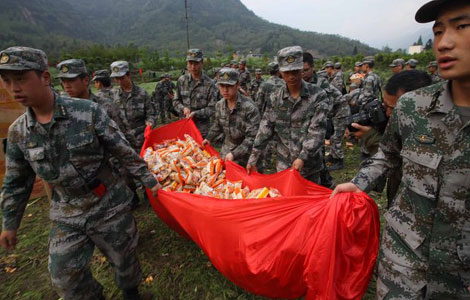 Quake takeaway from China's Air Force
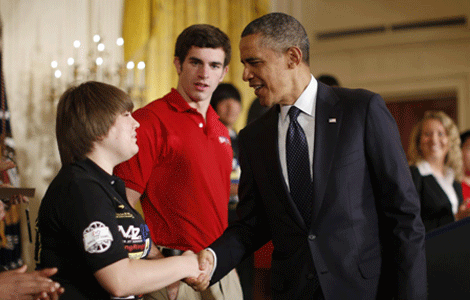 Obama celebrates young inventors at science fair
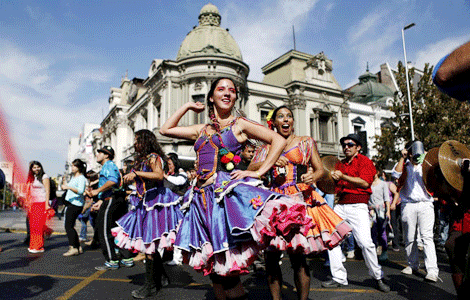 Earth Day marked around the world
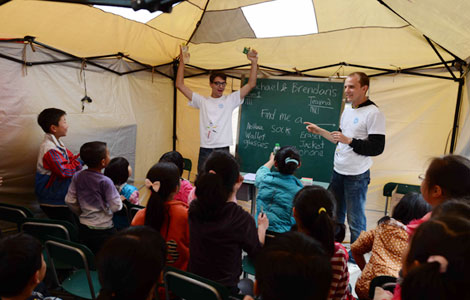 Volunteer team helping students find sense of normalcy
 Ethnic groups quick to join rescue efforts
Most Viewed
Editor's Picks
|
|

|

|

|
|
Today's Top News
Chinese fleet drives out Japan's boats from Diaoyu
Health new priority for quake zone
Inspired by Guan, more Chinese pick up golf
Russia criticizes US reports on human rights
China, ROK criticize visits to shrine
Sino-US shared interests emphasized
China 'aims to share its dream with world'
Chinese president appoints 5 new ambassadors
US Weekly

|
|