Room at the top for Chinese
Updated: 2012-08-10 08:57
By Zhang Yuwei and Tan Yingzi (China Daily)
|
||||||||


|
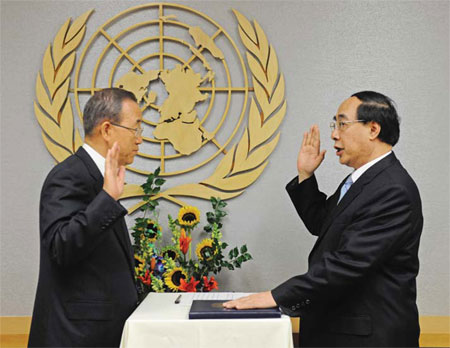
Wu Hongbo (right) is sworn in as the UN undersecretary-general for Economic and Social Affairs by Secretary-General Ban Ki-moon at the UN headquarters in New York on Aug 6, signaling an increasing presence of Chinese leaders at international organizations. Shen Hong / Xinhua |
Recent appointments herald opportunities for leaders in international organizations
There is a visible face to China's increasing influence in global affairs - or faces, to be precise, particularly in senior positions at international organizations in recent years.
Chinese diplomat Wu Hongbo is the most recent addition to this elite group, following Lin Jinhai's appointment as the secretary of the International Monetary Fund in March.
On Aug 6, Wu was sworn in as the new United Nations undersecretary-general for Economic and Social Affairs at the UN headquarters in New York.
Wu, 60, from Shandong province in eastern China, had been the Chinese ambassador to Germany since 2009. He was also China's former assistant foreign minister. He graduated from Beijing Foreign Studies University and pursued a master's degree from Victoria University in New Zealand from 1978 to 1980.
On May 31, UN Secretary-General Ban Ki-moon appointed Wu to this key position, succeeding Chinese diplomat Sha Zukang who had led the department since 2007.
An undersecretary-general is the highest position in the UN that can be held by a Chinese citizen, as there is a convention that the UN secretary-general cannot come from the five permanent members of the UN Security Council: China, France, Russia, the United States and Britain.
Zhu Zhiqun, professor of political science and international relations at Bucknell University in Lewisburg, Pennsylvania, says Wu is "fully qualified and competent" for this role because of his diverse background serving as ambassador to both developed nations (Germany) and developing nations (the Philippines) in addition to working at China's foreign ministry.
"Wu's background and first-hand experience in development issues will be helpful for him as he leads UN efforts to implement the consensus-program plans reached at the Rio+20 development summit," he says.
On his new position, Wu says one of the priorities in leading DESA is to help implement the eight Millennium Development Goals, which include ending extreme poverty, halting the spread of HIV/AIDS and providing universal primary education.
All 193 UN member states have agreed to try to achieve these by 2015.
"What happens after 2015 remains a key question," says Wu, adding that development issues were still the most pressing ones for the international community.
"One of the priorities on my work agenda, despite just taking office, is that I will lead my team to help implement the MDGs for the last three years before the deadline, and propose a framework for the follow-up of the post-2015 MDGs," Wu says.
Development issues had a different and broader meaning, and the MDGs and sustainable development goals can be integrated, Wu told a group of Chinese resident UN reporters after his swearing-in ceremony.
"Now it includes economic, social and environmental issues. Effectively dealing with these issues will help build a better world for our future generations," he adds.
But the veteran diplomat also sees some trials ahead.
"There are some big challenges to integrate the MDGs and sustainable development goals because the latter go far beyond the MDGs," says Wu.
"One thing we have to do is to make sure developing nations understand that the integration of the two will still protect both their interests and the interests of the least-developed countries."
He said some developing countries might fear they would lose some of the assistance promised when the MDGs were set up.
From his personal perspective, Wu found it quite a transition to shift from being a Chinese diplomat to an international civil servant for the UN.
"In my previous jobs, all my colleagues were Chinese, but now I have colleagues from different parts of the world," he says.
"The goal of my work changes too. It changes from serving my country to serving the international community, which of course includes protecting the interests of China.
"There is no conflict between the two."
UN statistics show that China contributed $74.9 million to the organization's annual budget in 2011 - the eighth largest among the 193 UN members.
The number of UN staff allowed for each member country is determined using a formula that includes demographics and GDP, with budget contributions being a decisive factor.
China currently has fewer than 500 staff at the UN Secretariat, which is the least among the five permanent members of the UN Security Council and fewer than UN members such as Pakistan and Japan, according to Zhang Yi, deputy director of the Secretariat of the United Nations Association of China.
"Wu's appointment, though succeeding another Chinese, is significant and suggests that China will continue to have a voice at key international organizations as it becomes a major player in international politics and economics," Zhu says.
"In fact, the World Bank, the IMF, the World Health Organization and other international organizations are likely to have more Chinese faces at the top leadership level in the future."
Preceding Wu and Sha at the UN was Chen Jian, the undersecretary-general for General Assembly Affairs and Conference Service of the UN from 2001 to 2007.
Wu Jianmin was elected president of the International Exhibitions Bureau in 2003. Margaret Chan from Hong Kong became director-general of the World Health Organization in 2006.
Lin Jianhai was the first Chinese-born expert to become the IMF secretary. He is the third Chinese national to join the management ranks of international financial institutions.
He follows Justin Yifu Lin, a former chief economist at the World Bank, and Zhu Min, whose current post as one of three deputy managing directors puts him among the top five IMF officials.
Analysts say that this trend reflects China's strength and responsibility as the world's second-largest economy, but the increase in the number of high-level Chinese officials in international organizations does not match the growth of China's national strength.
When Lin Jianhai joined the IMF in 1989, there were only three Chinese staff members. Now about 100 Chinese are employed by the IMF, including 60 permanent staff members.
Lin, 57, graduated from Beijing's University of International Business and Economics in 1974. Later, he earned a master's degree at the University of California, Berkeley, and a doctorate in international finance from the George Washington University.
Due to language and cultural barriers, he says the best way for Chinese to adapt to the international working environment is to learn and observe.
"I used to carry a little notebook with me and took notes of the new English terms and phrases," Lin tells China Daily.
"Then I could talk and write like my peers at the IMF."
Lin hoped that more young Chinese economists will join the international financial institutions, making a contribution to world governance and also gaining more global experience.
Contact the writers at tanyingzi@chinadailyusa.com and yuweizhang@chinadailyusa.com
(China Daily 08/10/2012 page3)
 Relief reaches isolated village
 Rainfall poses new threats to quake-hit region
 Funerals begin for Boston bombing victims
 Quake takeaway from China's Air Force
 Obama celebrates young inventors at science fair
 Earth Day marked around the world
 Volunteer team helping students find sense of normalcy
 Ethnic groups quick to join rescue efforts
Most Viewed
Editor's Picks
|

|


|

|

|
|
Today's Top News
Chinese fleet drives out Japan's boats from Diaoyu
Health new priority for quake zone
Inspired by Guan, more Chinese pick up golf
Russia criticizes US reports on human rights
China, ROK criticize visits to shrine
Sino-US shared interests emphasized
China 'aims to share its dream with world'
Chinese president appoints 5 new ambassadors
US Weekly

|

|