Much to cheer about for keepers of the inn
Updated: 2012-08-31 07:46
By Wang Chao (China Daily)
|
||||||||


|
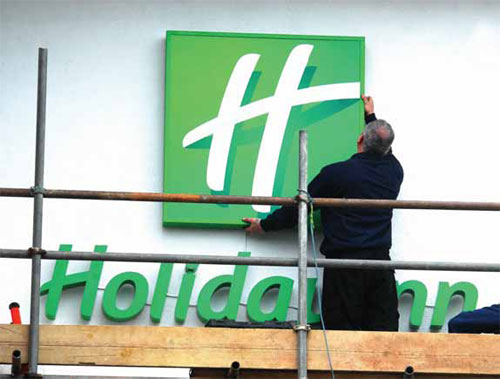
Holiday Inn's global makeover plan has included revamping signage. Provided to China Daily |
Although holiday inn is positioned as midscale, it continues to be seen as premium, says china executive
It has just celebrated its 60th birthday, but far from taking that as a hint for a rest, the hotel chain Holiday Inn is still going about its business with the zest of a teenager.
But the company periodically calls in the corporate chambermaids to let in some fresh air, and in China it is now doing just that. Twenty-eight years after Holiday Inn arrived in the country, becoming the first foreign hotel in China, its exotic novelty has become threadbare, and the company has set about recasting the brand.
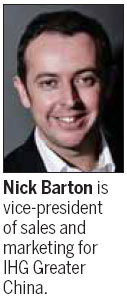
That is being achieved, it says, by targeting the country's middle class. Those are the people that Nick Barton, the vice-president of sales and marketing for InterContinental Hotels Group PLC Greater China, which operates the Holiday Inn hotel chain, calls "everyday heroes".
"Holiday Inn is for people who want to relax; it is famous for its hospitality," he says. "It targets the middle class that works hard, long days, and just wants to relax and stay in a comfortable place."
But recalibrating its market focus in China is just the latest of the chores IHG has set for itself in its Holiday Inn makeover. In 2007, it began modernizing lobbies, room fittings and bathrooms and improving exterior lighting, landscaping and signage, a task that was not complete until three years later. Nearly $1 billion was spent on updating 3,200 hotels and 430,000 rooms worldwide. The relaunch cut the average age of Holiday Inn and Holiday Inn Express hotels to 10 years.
In August, just as it was getting back its breath after blowing out the 60 candles on its birthday cake, Holiday Inn lit them up once again as it rolled out the carpet in its 60th hotel in China, near Changbai Mountain, a ski resort in the northeast. And the big 60 flashed up once again as IHG disclosed plans for that many new Holiday Inns in China over the next three to five years.
With the hotels it already has in the country, it now has 3,400 hotels worldwide, and every day something like 275,000 people lay their heads on one of its pillows.
Just how important China is to IHG's expansion plans can be seen in a recent company report, according to which 30 percent of the properties on its drawing board are in greater China. Of those, 70 percent are being built.
In greater China, IHG says, it opened 3,382 rooms in eight hotels in the six months ended Aug 7, taking its total number of rooms in the region to 58,184. Openings included two Crowne Plazas and five Holiday Inns, including the largest Holiday Inn in the world, in Macao, which has 1,224 rooms.
The group has about 5 percent of the global hotel industry and expects to double that over the next 20 years, with most of the growth in the US, China and India, HotelNewsNow, a US-based website, quoted Richard Solomons, CEO of IHG, as saying.
The strong resilience of the Chinese hotel market amid the global economic gloom has reinforced IHG's confidence in China. Euromonitor International, a research company in London, says the global hotel industry's revenue grew 9 percent to $457 billion last year, driven by the resurgence in business travel. The Chinese hotel market was ranked the second-best-performing, sales increasing by $7.2 billion, an increase only $200 million less than that of the US market.
Barton puts Holiday Inn's early success in China to the principle of the early bird catching the worm.
"We entered China in 1984 with Holiday Inn Lido (in Beijing), and later opened in Qingdao and Chongqing (which) were pretty much the best in town in the 1980s. We have a rich heritage in China, and among Chinese travelers Holiday Inn is among the brands that they recognize the most," he says.
"We have benefited a lot from our early entry. Now none of the other international brands has the experience and heritage to compete with us in the mid-scale range."
But success can sometimes breed its own problems, and in the years after Holiday Inn arrived in China it created such a marquee name for itself that it was beyond the reach of most Chinese.
Now, as international competitors swarm into the country, the brand is looking at its roots, those left by Kemmons Wilson, a home builder, when he opened the first Holiday Inn in Memphis, Tennessee, in 1952.
Wilson is said to have come up with the idea after a road trip with his family from Tennessee to Washington that left him disgruntled about dirty, cramped and expensive motels. His answer was simple: to provide comfortable accommodation that families could afford. Within 20 years 1,400 Holiday Inns had opened worldwide and in June 1972 Wilson appeared on the front cover of Time magazine, branded as "the man with 300,000 beds".
But in 2012 it is not just bed numbers that are on Barton's mind.
"Upscale hotels are being built everywhere, but I think you have to balance that with the rise of the mass middle class," he says.
With the expansion of the hotel market in China over the past 20 years, IHG has brought brands such as Crowne Plaza and InterContinental to the country, but that has not devalued the Holiday Inn brand, Barton says.
"I think Holiday Inn will continue to be seen as pretty premium. Although we position Holiday Inn as midscale, it is so well loved by Chinese customers."
In IHG's brand portfolio, Crowne Plaza is for executives building their careers on their way to success, people IHG calls strivers.
"So we make sure we have meeting facilities and good technology that can meet their needs.
"And InterContinental is for people who really want to know the world."
As for Holiday Inn, its overriding ethos is homeliness, Barton says, and there are no plans to change that.
"We are not going to change that status just because the five-star hotel market is booming and Chinese people treat it as a premium."
Barton projects that by 2020 the Chinese market will be as big as that of the US, where there are 2,725 Holiday Inns.
"By 2020 there will be 200 cities with more than 1 million people, which is a very big market."
wangchao@chinadaily.com.cn
(China Daily 08/31/2012 page16)
 Relief reaches isolated village
 Rainfall poses new threats to quake-hit region
 Funerals begin for Boston bombing victims
 Quake takeaway from China's Air Force
 Obama celebrates young inventors at science fair
 Earth Day marked around the world
 Volunteer team helping students find sense of normalcy
 Ethnic groups quick to join rescue efforts
Most Viewed
Editor's Picks

|

|


|

|

|

|
Today's Top News
Chinese fleet drives out Japan's boats from Diaoyu
Health new priority for quake zone
Inspired by Guan, more Chinese pick up golf
Russia criticizes US reports on human rights
China, ROK criticize visits to shrine
Sino-US shared interests emphasized
China 'aims to share its dream with world'
Chinese president appoints 5 new ambassadors
US Weekly

|

|