Interpretation of a dream
Updated: 2012-08-31 07:47
By Yang Yang (China Daily)
|
||||||||


|
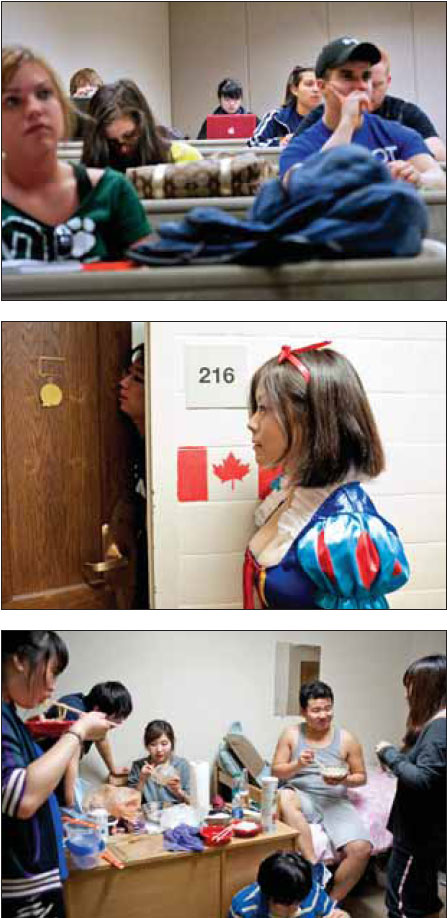
From top: A Chinese student sits at the back of a classroom. Students prepare for a costume party. Chinese students eat noodles together. Photos provided to China Daily |
The US promises an abundance of opportunity, but not everyone finds it easy to assimilate
The "American dream" has been immortalized in film and literature, its promise reaching over time and across oceans. In recent years an increasing number of Chinese students, bearing their parents' great expectations, have flooded into the United States to pursue this dream - which may not be as glittering as they imagined.
Darcy Holdorf, a 29-year-old US citizen, has a different goal. She aims to continue her exploration of life and the world, especially her connection with China.
Although her name is barely known in China, Holdorf's photography featuring Chinese students at Ohio University has attracted more than 73,000 comments since it was published in April by 163.com, the Chinese Internet portal.
The photographs set off debate about costly overseas study and landed Holdorf a bronze medal in documentary photography at the US-based 66th College Photographer of the Year award.
Holdorf says she did not discover her lifelong pursuit until college. As a girl in San Francisco, she used to read National Geographic magazine and dream of working for it and traveling around the world. But as she grew, her dream did too.
"I studied sociology at San Francisco State University. I took a photojournalism class. It was my second year in college and from then on I never looked back."
In San Francisco, Holdorf was surrounded by a diverse and rich immigrant history. She was familiar with Asian faces and became interested in languages and immigration at high school.
In the fall of 2010, she enrolled in a master's degree in photojournalism at Ohio University. Having just returned from China, she was surprised to see many of Chinese students at the university, which is located in Athens, a city not as large or diverse as her native San Francisco.
She then started to find out what these students, thousands of kilometers away from their middle-class parents in big Chinese cities such as Shanghai and Guangzhou, were doing in a small US city and how their life was going.
Holdorf discovered that the number of Chinese undergraduate students at Ohio University had grown from 17 students in 2004 to 603 students in 2010. That same year, 81 percent of all international students at the university came from China.

She asked around and talked to people, tried to make friends with the Chinese students, and found that they were living a detached existence.
"Before I started to photograph them, I didn't know enough about the situation. I could tell the Chinese community was very separate. I didn't realize how isolated they really were, how institutionalized the situation was. I wanted to find out more and share," Holdorf says.
There was a "Chinatown" at the school - a residential hall by the name of Scott Quad, where 180 of the 215 residents were Chinese students. Most of them were shy when it came to talking about themselves. Holdorf tried to interview as many students as possible, and her photos feature three main characters - Popo Huang, Andy Liu and Clara Zhang.
Holdorf started shooting pictures in spring last year, and published them as Not Here or There in early June. After the pictures appeared online, the Chinese students continued to communicate with her.
"I don't think they were upset about the story at that time," she says.
However, when the pictures were published in China under the title The Lost Dream of Chinese Overseas Students, they shocked many of those who saw them, angered parents who had sent or wanted to send their children overseas, and gave rise to debate about the meaning and merit of overseas study.
The pictures show how different the situation of these students is from what their parents and many Chinese people imagine.
They are unable to communicate due to poor English-language skills and an inadequate understanding of the local culture, which prevents even those who want to do so from blending in. As a result, they prefer to stay inside their own circle.
One photograph shows some Chinese students attending an English class in order to pass the required language test for foreign students. Some students have to go through the course five to six times, at a cost of 65,000 yuan ($10,222, 8,149 euros) each time.
Other pictures display the feeling of getting lost in another culture: a girl lying in a bed reading her cell phone, another standing in the afternoon light with a fringe covering her eyes and her shadow stretching behind her, and a girl sitting alone behind some American students concentrating on her computer.
The parents of the students portrayed were undoubtedly the most upset. They called their children and demanded that Holdorf delete the pictures, worried that once more Chinese people were exposed to these photos, the attraction of a foreign education would be diminished and their children's future would be ruined, not to mention the fact that they had spent large sums of money.
"I didn't imagine it ... I do think it is an important story for people in China to see. But I didn't know it would (reach the Chinese people). I didn't plan to do it. I did not try to sell it either. I was approached by 163.com to publish it," Holdorf says.
"They were very angry. Some students, whom I didn't know or work with very closely in the US, were very angry. They started threatening to sue me. They did all kinds of things out of anger and fear. They were very upset about their parents.
"I talked to them and gave them my number ... I was misunderstood and I just tried to explain that I've always been honest about what I was doing. I am a photojournalist. They knew that, I always told them that, but probably they never realized (the pictures) would make it home."
Holdorf says the biggest issue for Chinese students is the language barrier.
"Ohio University changed their requirements for English, starting to let more students in, those with lower English levels. It's much more difficult for them to communicate ... Some students even prefer to speak with me in Chinese.
"Obviously the living situation was very bad, and that changed this year. They no longer put all Chinese students in one building, which was really a stupid idea at the very beginning."
There are a lot of deep cultural differences that result in more misunderstandings, she says.
"Chinese people generally don't know much about the US. When a young Chinese student comes to the US, he is usually expecting New York or Los Angeles. But when they arrive in Athens, they (will be disappointed to) see the city is poor, a very rural neighborhood, not at all what they have imagined.
"The second thing is that the school is a party school. Even as an American, I don't relate to that culture, so for Chinese students it's even more difficult because these days, drinking has become the biggest pastime for students at OU ... For a young Chinese student, it's really hard to relate to. And even if Chinese students want to go out to a party, it might be very uncomfortable. Then you'll retreat back to your own community."
Holdorf has since graduated from Ohio University, and recently arrived in China. She is now working as a freelance photojournalist.
yangyangs@chinadaily.com.cn
(China Daily 08/31/2012 page20)

 Relief reaches isolated village
 Rainfall poses new threats to quake-hit region
 Funerals begin for Boston bombing victims
 Quake takeaway from China's Air Force
 Obama celebrates young inventors at science fair
 Earth Day marked around the world
 Volunteer team helping students find sense of normalcy
 Ethnic groups quick to join rescue efforts
Most Viewed
Editor's Picks

|

|


|

|

|

|
Today's Top News
Chinese fleet drives out Japan's boats from Diaoyu
Health new priority for quake zone
Inspired by Guan, more Chinese pick up golf
Russia criticizes US reports on human rights
China, ROK criticize visits to shrine
Sino-US shared interests emphasized
China 'aims to share its dream with world'
Chinese president appoints 5 new ambassadors
US Weekly

|

|