Ready for the big league
Updated: 2012-11-23 08:54
By Lin Jing and Xue Chaohua (China Daily)
|
||||||||


|
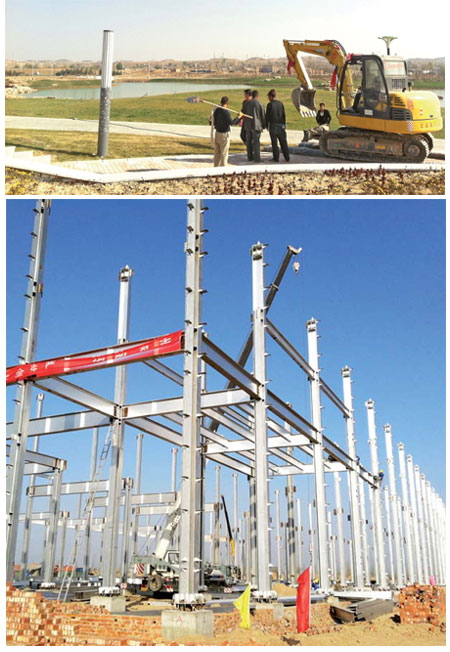
Top: The man-made lake in Lanzhou New Area is under construction. Above: The new Gansu JOY Agricultural Technology Co Ltd factory goes up. Photos by Lin Jing / China Daily |
Lanzhou plans massive infrastructure expansion drive to attract more foreign direct investment
Extensive transport and logistics networks, a slew of investor-friendly policies and new-energy industries are expected to be the tipping points for Lanzhou, as the capital city of Gansu province in Northwest China slowly inches up in the foreign direct investment rankings. The city was already a key distribution center on the ancient Silk Road trade route and a well-known transportation hub, but not a major destination for FDI.
In August, the government gave new impetus to Lanzhou's growth by making it the fifth national-level development zone in China after Shanghai's Pudong New Area, Tianjin's Binhai New Area, Chongqing's Liangjiang New Area and the Zhoushan Islands New Area in Zhejiang province.
Related reading: Going naturally with the flow
"The Lanzhou New Area marks China's latest effort to accelerate development of the western regions," Qin Yucai, director of the Western Development Department in the National Development and Reform Commission, said during a news conference in Beijing.
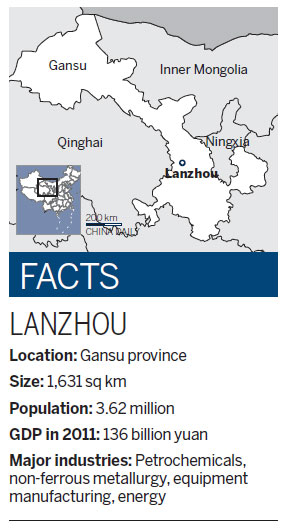
Yuan Zhanting, the mayor of Lanzhou, says that, "the new area will be the catalyst that will boost China's trade with the central and western Asian nations". The 800-square-kilometer new area is located 38 km to the north of the city center.
Lanzhou is already an important production base for petrochemicals, energy and raw materials in China, and has more than 40 industries covering 20,000 varieties of products. But the new area will essentially serve as a hub for the logistics and transportation industries. Lanzhou is one of the nine major comprehensive transportation hubs, and one of the 10 regional passenger railway transportation centers on China, apart from being the aviation transport hub and logistics center for northwestern China.
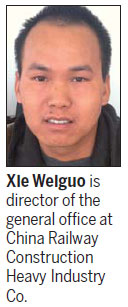
"The new area will be a crucial spot for companies looking to expand into the western regions of China," says Xie Weiguo, director of the general office at China Railway Construction Heavy Industry Co. According to Xie, the CRCHI unit in the New Area will be the company's first high-end equipment manufacturing center in the region and key to its future expansion in western China.
"As more companies expand into western China, there will also be an exponential increase in the demand for high-end equipment from the surrounding provinces and regions," he says.
CRCHI is specialized in research, design and manufacturing and construction of rail equipment and heavy machinery. Its parent company, China Railway Construction Corporation, is a large integrated construction group and a Fortune 500 company.
But CRCHI also was one of the first movers into Lanzhou New Area in 2010 and has since seen its fortunes climb rapidly.
"When we first came to this area, there was not enough tap water or any roads, only small hills. But after 10 months, the infrastructure of this area has grown fully," Xie says.
The company also plans to ramp up its workforce in the new area and will soon have 300 to 400 employees in Lanzhou, comprising technicians from its headquarters in Hunan province and blue-collar workers from the local labor market.
Apart from wooing domestic investors, the city is also exploring options to attract more foreign companies.
Yuan says that the city is trying to revitalize its position in the old Silk Road and working to export more products from East China through its railway network. It will also play a key role in connecting the Xinjiang Uygur autonomous region and other countries in the Central Asian region.
With an eye on long-term and sustained foreign investment, the city has embarked on a massive infrastructure expansion program.
Liu Weiping, governor of Gansu, says that Lanzhou will look to extend its role as a logistics center linking central and western Asia by building more railways and highways. The province already has three major arterial railway lines intersecting at Lanzhou, to create the largest railway hub in western China.
"Infrastructure spending in the Lanzhou New Area, till date, has been around 24.6 billion yuan ($3.95 billion; 3.07 billion euros)," he says.
The new area has so far attracted 90 investment projects, with an investment volume of 70.7 billion yuan. Eight of those projects are up and running.
Green strides
Li Rui, director of the Lanzhou New Area Management Committee, says that the next step is to attract more enterprises, especially Fortune 500 and top Chinese firms.
"We will have strict screening criteria for enterprises, based on environmental protection and growth potential," Li says.
Most of the industries in the new area are those involved in equipment manufacturing, petrochemicals, biomedical, new materials and modern services.
Some of the top 500 companies in China, such as Geely Automobile and Sany Heavy Industries, have already set up plants or are building factories in the new area.
Song Chengwan, project engineer with Sany Heavy Industries, says that Sany choose the new area because of the convenient transportation links and huge market potential.
"For Sany, Gansu ranks among the top five provinces in terms of sales. Besides, with a center in Lanzhou and the convenient transportation links, we can easily cover the business in Xining, Ningxia, Shaanxi, Chengdu and Chongqing. The potential is unlimited," Song says.
The company is mainly involved in construction machinery manufacturing, covering more than 120 products.
Sany entered the new area in October 2010 to begin work on two projects - a concrete mixing equipment unit with initial investment of 530 million yuan, and a mechanical maintenance center, at an outlay of 100 million yuan. Production at both these units is likely to start early next year.
"With Lanzhou being selected as the only state-level new area in Northwest China, Gansu will have a new growth engine," Song says.
"Our business will be largely enhanced as the construction of the new area itself will need huge amounts of concrete."
The company plans to hire more than 700 staff members, with 70 percent of them from local colleges and technical schools.
"Generally speaking, labor costs in Gansu are two thirds of that in other provinces."
But Song also questions whether the city officials have earmarked proper plans and strategies for sustainable development in the future.
"Lanzhou is a typical western province, short of water and green trees. I think the situation can change, but it requires long-term efforts from the local government for at least 20 years."
Li says environment protection is the crucial issue in attracting investment and developing the new area.
The local government has taken the first steps in this regard by planting 5.6 million trees in 29 sq km of the afforested areas. The new area envisages replanting 33 sq km of afforested areas every year to boost business and tourism.
Many other companies are being drawn to the new area because of favorable financial and tax policies.
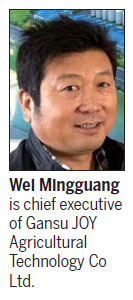
"Good supporting policies and fund-raising environment will make a huge difference for our company," says Wei Mingguang, chief executive of Gansu JOY Agricultural Technology Co Ltd. "We have better access to loans from banks and can leverage a large amount of money to start the project."
Spread over 0.42 sq km in the new area, the company plans to make sunflower oil, sunflower protein, and conduct research and development of sunflower seeds at its industrial park. "Seed costs will be reduced by more than 80 percent if we can use our own seeds rather than the imported seeds."
Production is expected to start by the end of the year. The company reported sales of 200 million yuan in 2011, and expects to end this year with sales of around 300 million yuan. JOY's total investment in the park is around 1.87 billion yuan. The first stage of investment is more than 400 million yuan with 200 million yuan coming from private capital and the rest from bank loans.
"Without enough financial support, it would be impossible for us to start such a big project," Wei says.
According to Wei, what Lanzhou really needs is to create a strong brand, and the new area is the best candidate for it.
Li says that a total of 2.38 billion yuan from Chinese banks has been received to support the financial needs of enterprises in Lanzhou New Area.
The area's GDP is expected to reach 50 billion yuan by 2015 and 270 billion yuan by 2030, and its population is likely to exceed 500,000 by 2020.
"We will fully utilize the opportunity to create a proper management and investment environment, and try to build the Lanzhou New Area into the most attractive and competitive region in Gansu, even in western China," he says.
Zhao Yinan contributed to this story.
Contact the writers at linjingcd@chinadaily.com.cn and xuechaohua@chinadaily.com.cn
(China Daily 11/23/2012 page12)
 Relief reaches isolated village
 Rainfall poses new threats to quake-hit region
 Funerals begin for Boston bombing victims
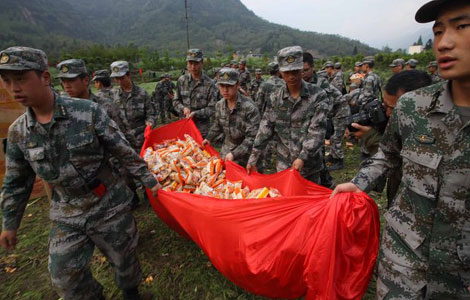 Quake takeaway from China's Air Force
 Obama celebrates young inventors at science fair
 Earth Day marked around the world
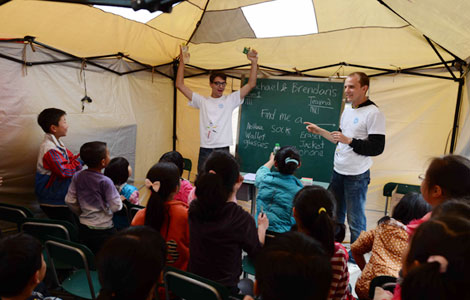 Volunteer team helping students find sense of normalcy
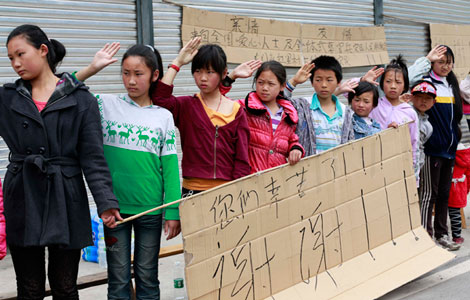 Ethnic groups quick to join rescue efforts
Most Viewed
Editor's Picks

|
|


|

|

|
|
Today's Top News
Chinese fleet drives out Japan's boats from Diaoyu
Health new priority for quake zone
Inspired by Guan, more Chinese pick up golf
Russia criticizes US reports on human rights
China, ROK criticize visits to shrine
Sino-US shared interests emphasized
China 'aims to share its dream with world'
Chinese president appoints 5 new ambassadors
US Weekly

|

|