Cambridge's Museum tells story of ancient China
Updated: 2012-05-04 11:09
(Xinhua)
|
||||||||


 |
|
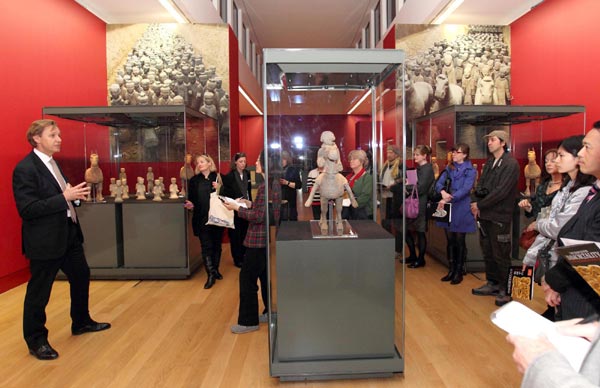
Started on Saturday and entitled "the Search for Immortality," the exhibition will feature more than 300 pieces of treasure in jade, gold, silver, bronze and ceramics from the Han Dynasty (206 BC - AD 220), which were recovered from tombs of the royal families. [Photo/Xinhua] |
CAMBRIDGE, Britain - The dazzling jade suits and vivid pottery dancers travelled their way to Cambridge in Britain from China, with stories about how immortality was pursued in ancient China.
Started on Saturday and entitled "the Search for Immortality," the exhibition will feature more than 300 pieces of treasure in jade, gold, silver, bronze and ceramics from the Han Dynasty (206 BC - AD 220), which were recovered from tombs of the royal families.
All the items on display came from two Chinese museums, the Xuzhou Museum and the Museum of the Mausoleum of the Nanyue King.
"This is the first time we have an exhibition with such a scale of Chinese artifacts, which are all from China," said Timothy Potts, director of the Fitzwilliam Museum.
Talking about the reason of holding such an exhibition, Potts said the Han period was important, with "great achievements in art, crafts and culture generally in this ancient time."
"Many of the pieces were not known even in China," he said. "There have been a lot of new research, a lot of new understanding about not only the Han culture itself, but its influences."
His view was echoed by James Lin, a senior assistant keeper with the museum.
Lin said the Han Dynasty has a profound influence on the Chinese culture, as after 2,000 years, people are still using the expressions like Han nationality and Hanyu, which means Mandarin.
"Like those living in the Han Dynasty, many Chinese people are still believing in the afterlife, and would burn paper-made utilities for the dead ones," he said.
What's more, the Chinese people have developed a special love for jade. "As we can see, many of the items at this exhibition are made of jade, which was believed to guard its owner against evils so many years ago," Lin added.
The exhibition was held in four galleries arranged following a layout of a tomb.
At the first gallery stand pottery guards, which were made to protect the owner of the tomb from outside disturbance, while some lifelike pottery musicians and dancers in another gallery were placed to amuse the lord.
All kinds of utilities used in daily life, such as kitchenware and bathing tools, could be found in the tomb.
The most interesting item among the goods is a stone lavatory, which is almost the same size and appearance as those used nowadays in China.
Lin said, "An exhibition needs to tell a story, so we put treasures from the two museums together so as to show the visitors power struggles for imperial legitimacy at that time."
"Founder of the Han Dynasty made his own brother overlord in the militarily crucial place of Xuzhou," he told Xinhua. "As a result, the city of Xuzhou boasts many treasures from the Han Dynasty."
The first king of Nanyue used to be a commander guarding south China, but he made himself emperor later.
"To show his equal position as the Han emperor, the king of Nanyue wore a jade suit as well after his death," Lin said.
The suit is composed of 2,291 pieces of jade and weaved with silk.
In comparison, Fitzwilliam shows another jade suit from a Han overlord, which was weaved by gold thread and the jade was apparently better in quality.
According to Wu Lingyun, curator of the Museum of the Mausoleum of the Nanyue King, the exhibition also shows a small bottle with delicate patterns, which were used to collect morning dew for the king to drink.
"We have also found ivory from Africa and mastic gum from west Asia," Wu said. "We have always thought that such place as Nanyue, which is far from the central China, could be less developed. But traces of foreign trade could be found there 2,000 years ago. Just imagine how powerful the Han could be."
Mentioning the loss of Chinese artifacts from Fitzwilliam last month, Wu said "they have attached great importance to that, and increased guards and monitors."
"I believe that they could ensure the security of the Chinese treasures, which is also the hope of the peoples from both countries," he said.
The exhibition will last till November 11.
 Relief reaches isolated village
 Rainfall poses new threats to quake-hit region
 Funerals begin for Boston bombing victims
 Quake takeaway from China's Air Force
 Obama celebrates young inventors at science fair
 Earth Day marked around the world
 Volunteer team helping students find sense of normalcy
 Ethnic groups quick to join rescue efforts
Most Viewed
Editor's Picks
|

|


|

|

|

|
Today's Top News
Health new priority for quake zone
Xi meets US top military officer
Japan's boats driven out of Diaoyu
China mulls online shopping legislation
Bird flu death toll rises to 22
Putin appoints new ambassador to China
Japanese ships blocked from Diaoyu Islands
Inspired by Guan, more Chinese pick up golf
US Weekly

|
|