Social media give a view of buyers
Updated: 2012-08-12 07:52
By Stephanie Clifford (The New York Times)
|
||||||||


|
|
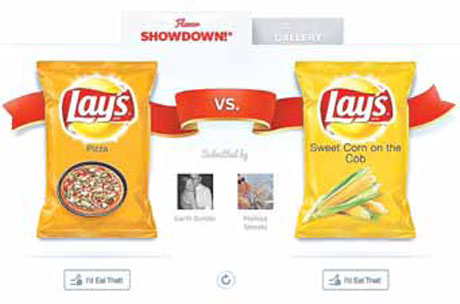
Frito-Lay is developing a new potato chip flavor, which, in the old days, would have involved a series of focus groups, research and trend analysis.
Now, it uses Facebook.
Visitors to the new Lay's Facebook app are asked to suggest new flavors and click an "I'd Eat That" button to register their preferences. So far, the results show that a beer-battered onion-ring flavor is popular in California and Ohio, while a churros flavor is a hit in New York.
Frito-Lay has run the contest outside the United States, resulting in chip flavors like hot and spicy crab in Thailand and pickled cucumber in Serbia.
"It's a new way of getting consumer research," said Ann Mukherjee, chief marketing officer of Frito-Lay North America. "We're going to get a ton of new ideas."
Companies like Wal-Mart and Samuel Adams are turning social media sites into extensions of market research departments. And companies are just beginning to figure out how to use the huge amount of information available.
When Wal-Mart wanted to know whether to stock lollipop-shaped cake makers in its stores, it studied Twitter. Estee Lauder's MAC Cosmetics brand asked social media users to vote on which discontinued shades to bring back. The stuffed-animal brand Squishable solicited Facebook feedback before settling on the final version of a new toy. And Samuel Adams asked users to vote on yeast, hops, color and other qualities to create a crowdsourced beer that got rave reviews.
"It tells us exactly what customers are interested in," said Elizabeth Francis, chief marketing officer of the Gilt Groupe, a shopping Web site. Gilt asks customers to vote on products to include in sales, and sets up Facebook chats between engineers and customers to help refine products. "It's amazing that we can get that kind of real feedback, as opposed to speculating," Ms. Francis said.
Wal-Mart acquired the social media company Kosmix last year for an estimated $300 million, chiefly because of Kosmix's ability to extract trends from social media conversations.
The unit, now called @WalmartLabs, looks at Twitter posts, public Facebook posts and search terms on Walmart.com, among other cues, to help Wal-Mart refine what it sells. Its technology can identify the context of words, distinguishing "Salt," the Angelina Jolie movie, from salt, the seasoning, for example. It sets baselines for what a normal level of excitement around, say, electronics or toys is, so it can measure when interest is getting high. It also analyzes sentiment, because if people overwhelmingly dislike a new video game, ordering pallets of the game is not a great bet.
"There's mountains and mountains of data being created in social media," said Ravi Raj, vice president for products for @WalmartLabs.
After Wal-Mart started carrying a spicy chip called Takis, @WalmartLabs found that most of the positive chatter about it was coming from California and the Southwest.
The merchants, judging that they could sell additional products in those states, commissioned a similar spicy chip from Wal-Mart's private-label brand and introduced another, called Dinamita, from Doritos. Wal-Mart began selling both lines in California and the Southwest earlier this year, and is now adding them to other stores. For Frito-Lay, seeking product ideas on Facebook, via the Lay's Do Us a Flavor app, has a few advantages.
Once the company sees what is popular and where, it can tailor its products to specific areas of the country. While Frito-Lay will produce three of the flavors from its contest and give a $1 million prize to the creator of one of those flavors, Ms. Mukherjee said the company would also study other suggestions. "This is a real competitive edge for us," she said.
The social media approach also attracts younger customers. People who sign up for focus groups or consumer panels are generally not young fad followers, but Facebook users often are, so adding social media to the mix lets Frito-Lay get a wide range of consumer feedback.
Marketers are trying to find a balance between privacy concerns and the rich data available online. Mr. Raj said Wal-Mart analyzed only Facebook posts that users made public. On the other hand, apps like Frito-Lay's require access to a user's location, gender, birthday, photos, list of friends and status updates; the products for which he or she has clicked "like"; and more.
For the most part, when someone uses a brand's Facebook app, the brand can obtain a range of personal information, said Mark LaRow, the senior vice president for products at the software company MicroStrategy. Microstrategy has built its own app, Wisdom Network, that can gain access to about 13 million private Facebook profiles once a user gives it permission.
The app gathers information about users and their friends. Marketers might use the data to see what current or potential customers do and like, or what rich customers prefer versus poorer ones.
"This is like the biggest focus group someone could ever imagine," Mr. LaRow said.
|
|

 Relief reaches isolated village
 Rainfall poses new threats to quake-hit region
 Funerals begin for Boston bombing victims
 Quake takeaway from China's Air Force
 Obama celebrates young inventors at science fair
 Earth Day marked around the world
 Volunteer team helping students find sense of normalcy
 Ethnic groups quick to join rescue efforts
Most Viewed
Editor's Picks

|

|


|

|

|

|
Today's Top News
Health new priority for quake zone
Xi meets US top military officer
Japan's boats driven out of Diaoyu
China mulls online shopping legislation
Bird flu death toll rises to 22
Putin appoints new ambassador to China
Japanese ships blocked from Diaoyu Islands
Inspired by Guan, more Chinese pick up golf
US Weekly

|

|