Full Text: China Adheres to the Position of Settling Through Negotiation the Relevant Disputes Between China and the Philippines in the South China Sea
Updated: 2016-07-13 15:06
(Xinhua)
|
||||||||


66. Fourth, neither "contiguity or proximity" nor national security is a basis under international law for acquiring territory. Many countries have territories far away from their metropolitan areas, in some cases even very close to the shores of other countries. When exercising colonial rule over the Philippines, the United States had a dispute with the Netherlands regarding sovereignty over an island which is close to the Philippine Archipelago, and the United States' claim on the basis of contiguity was ruled as having no foundation in international law. Furthermore, it is just absurd to invade and occupy the territory of other countries on the ground of national security.
67. Fifth, the Philippines claims that some islands and reefs of China's Nansha Qundao are located within its exclusive economic zone and continental shelf and therefore should fall under its sovereignty or form part of its continental shelf. This is an attempt to use maritime jurisdiction provided for under UNCLOS to deny China's territorial sovereignty. This runs directly counter to the "land dominates the sea" principle, and goes against the purpose of UNCLOS, as stated in its preamble, to "establish [...] with due regard for the sovereignty of all States, a legal order for the seas and ocean". Therefore, a coastal state can only claim maritime jurisdiction under the precondition of respecting the territorial sovereignty of another state. No state can extend its maritime jurisdiction to an area under the sovereignty of another; still less can it use such jurisdiction as an excuse to deny another state's sovereignty or even to infringe upon its territory.
68. Sixth, the Philippines' so-called "effective control" on the basis of its illegal seizure is null and void. The international community does not recognize "effective control" created through occupation by force. The Philippines' "effective control" is mere occupation by naked use of force of some islands and reefs of China's Nansha Qundao. Such occupation violates the Charter of the United Nations and the basic norms governing international relations and is unequivocally prohibited by international law. This so-called "effective control" based on illegal seizure cannot change the basic fact that Nansha Qundao is China's territory. China firmly opposes any attempt to treat the seizure of some islands and reefs of China's Nansha Qundao as a so-called "fait accompli" or "status quo". China will never recognize such a thing.
iii. The development of the international law of the sea gave rise to the dispute between China and the Philippines over maritime delimitation
69. With the formulation and entering into effect of UNCLOS, the relevant disputes between China and the Philippines in the South China Sea have gradually intensified.
70. Based on the practice of the Chinese people and the Chinese government in the long course of history and the position consistently upheld by successive Chinese governments, and pursuant to China's national law and under international law, including the 1958 Declaration of the Government of the People's Republic of China on China's Territorial Sea, the 1992 Law of the People's Republic of China on the Territorial Sea and the Contiguous Zone, the 1996 Decision of the Standing Committee of the National People's Congress of the People's Republic of China on the Ratification of the United Nations Convention on the Law of the Sea, the 1998 Law of the People's Republic of China on the Exclusive Economic Zone and the Continental Shelf, and the 1982 United Nations Convention on the Law of the Sea, China has, based on Nanhai Zhudao, internal waters, territorial sea, contiguous zone, exclusive economic zone and continental shelf. In addition, China has historic rights in the South China Sea.
71. The Philippines proclaimed its internal waters, archipelagic waters, territorial sea, exclusive economic zone and continental shelf according to, among others, the Philippines' Republic Act No. 387 of 1949, Republic Act No. 3046 of 1961, Republic Act No. 5446 and Presidential Proclamation No. 370 of 1968, Presidential Decree No. 1599 of 1978, and Republic Act No. 9522 of 2009.
72. In the South China Sea, China and the Philippines are states possessing land territory with opposite coasts, the distance between which is less than 400 nautical miles. The maritime areas claimed by the two states overlap, giving rise to a dispute over maritime delimitation.
- Chinese defense minister rejects South China Sea arbitration award
- Serbia supports peaceful resolution of South China Sea dispute
- Czech expert warns US and the Philippines not to play fire in South China Sea
- Overseas Chinese urged to support sovereignty for South China Sea
- Net users angry at tribunal's ruling over South China Sea
- Wider support for China's South China Sea stance
- Arbitration body 'has nothing to do' with us, says UN
- Trump expected to make VP announcement on Friday
- 25 killed, 50 injured as trains collide in Italy
- The South China Sea Arbitration: Illegal, Illegitimate and Invalid
- Theresa May set to be UK's next Prime Minister after rival stands down
- Killing of UN Chinese peacekeepers slamed

 Ruling 'null and void', with no binding force
 Sports star Ivanovic, Schweinsteiger holds wedding in Venice
 Tim Duncan announces retirement after 19 seasons with Spurs
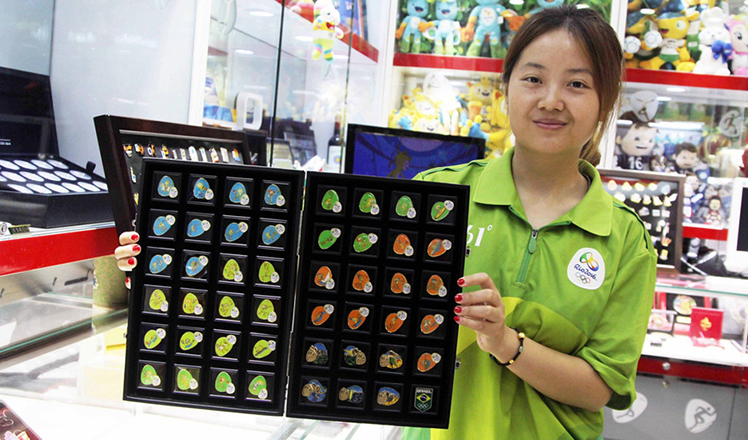 Merchandize for Rio 2016 a hit in run-up to games
 Top 10 best Chinese cities to own a house
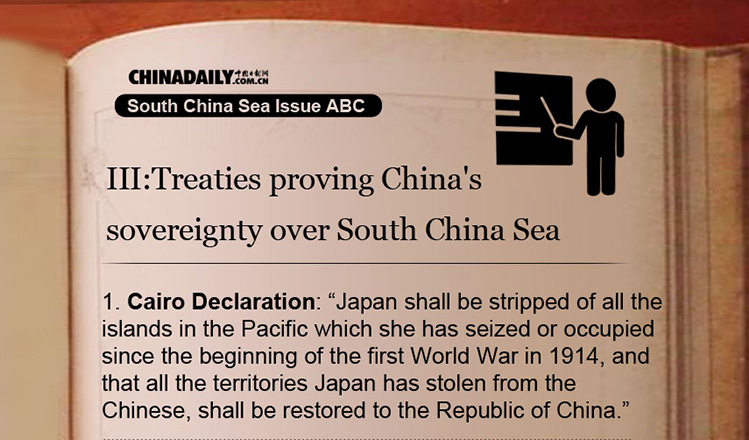 Getting to know South China Sea Issue
 Ronaldo-less Portugal wins Euro 2016 title
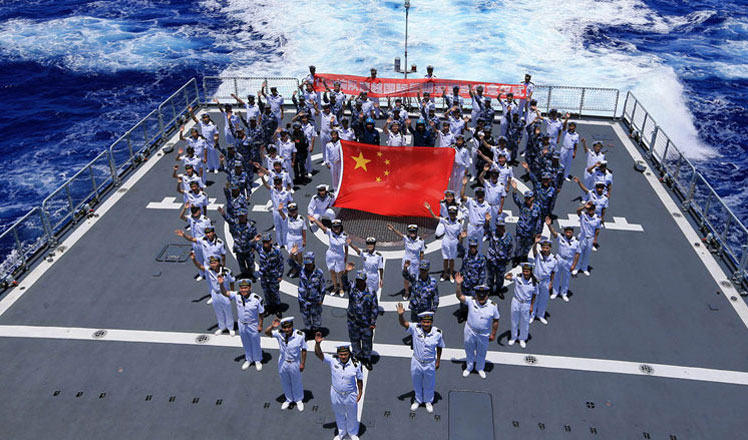 Chinese navy fleet joins RIMPAC 2016 open day
Most Viewed
Editor's Picks

|

|


|
|

|

|
Today's Top News
Ministry slams US-Korean THAAD deployment
Two police officers shot at protest in Dallas
Abe's blame game reveals his policies failing to get results
Ending wildlife trafficking must be policy priority in Asia
Effects of supply-side reform take time to be seen
Chinese State Councilor Yang Jiechi to meet Kerry
Chinese stocks surge on back of MSCI rumors
Liang avoids jail in shooting death
US Weekly

|

|