China: Seeking a clear day
Updated: 2016-09-30 12:12
(China Daily USA)
|
||||||||


China will launch its emissions trading system next year, aiming to make it the world's biggest carbon-trading market and help the largest greenhouse emitting country to reduce pollution, Paul Welitzkin reports from New York
It's the world's largest in just about everything, from population (1.4 billion) to man-made structure (the Great Wall, 5,500 miles). And now China is trying to get rid of one "largest" while creating another one.
Next year, China - the world's largest emitter of greenhouse gases - plans to implement a national emissions trading system (ETS) that will create the world's largest carbon-trading market and cover nearly half of its economy. The free-market approach to pollution control will be closely watched in the US and other developed nations.
It's an ambitious goal that Chinese President Xi Jinping committed the nation to after a meeting with US President Barack Obama in 2015 at which the world's two biggest economic powers pledged to reduce carbon dioxide (CO2) emissions to tackle climate change.
"Once China begins to implement this, then other countries will begin to think about how to address the issue," said Dale Jorgenson of Harvard University. "Certainly the US will be in the forefront of this because of the discussions that have already taken place between the two presidents."
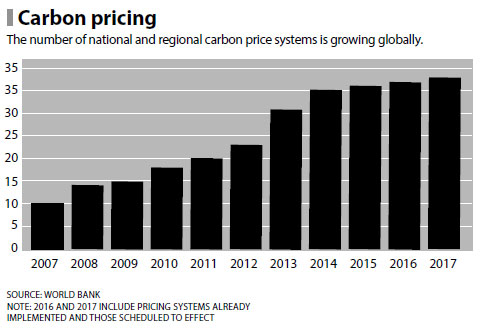
At the Obama-Xi meeting, China formally unveiled a cap-and-trade program, or ETS. It's part of an effort to put a price on carbon as a means of bringing down emissions and driving investment into cleaner options.
"Instead of dictating who should reduce emissions where and how, a carbon price gives an economic signal and polluters decide for themselves whether to discontinue their polluting activity, reduce emissions, or continue polluting and pay for it," said the World Bank.
Pricing carbon
There are two ways to price carbon. The ETS, or cap-and-trade, places a limit on greenhouse gas emissions and allows industries with low emissions to sell their extra allowances to larger emitters. By creating supply and demand for emissions allowances, an ETS establishes a market price for greenhouse-gas emissions.
 Top 10 Chinese cities with 'internet plus transportation’
 New energy cars shine at Paris Motor Show
 23 baby giant pandas make debut in Chengdu
 Heritage list salutes Chinese architecture
 Happy hour for prince and princess in Canada
 Chinese and Indian sculptures on display at the Palace Museum in Beijing
 Rescue work at the typhoon-hit provinces
 Wonderland-like sunrise in East China
Most Viewed
Editor's Picks
|
|

|

|
|

|
Today's Top News
Trump outlines anti-terror plan, proposing extreme vetting for immigrants
Phelps puts spotlight on cupping
US launches airstrikes against IS targets in Libya's Sirte
Ministry slams US-Korean THAAD deployment
Two police officers shot at protest in Dallas
Abe's blame game reveals his policies failing to get results
Ending wildlife trafficking must be policy priority in Asia
Effects of supply-side reform take time to be seen
US Weekly

|

|