Asia has more millionaires than US: study
Updated: 2015-09-17 11:36
By Paul Welitzkin in New York(China Daily USA)
|
||||||||


Led by China and India, Asia had more millionaires than the United States and Canada in 2014, according to a wealth management study.
The study, done by the Capgemini consulting concern and RBC Wealth management, found that the number of high net-worth individuals (HNWI) increased by 11.4 percent to 4.67 million in the Asia-Pacific region, about 6,400 more than in the US and Canada. HNWIs were defined as those with investable assets of $1 million or more.
China and India have propelled Asia-Pacific HNWI growth in recent years and are expected to continue to act as drivers both regionally and globally despite recent market volatility, according to Michael Yong-Haron, head of North Asia for RBC Wealth Management.
"These two markets represent nearly 10 percent of global HNWI wealth, and account for 17 percent of the global increase in new wealth since 2006, adding $3.2 trillion during that time. Of the $7.4 trillion of HNWI wealth added in Asia-Pacific since 2006, India and China accounted for 43 percent," Yong-Haron said Wednesday.
Both China and India, where 1 out of 3 people in the world reside, have experienced rapid economic growth.
Data in the study do not include the stock market selloff in China over the summer. "The high net worth population and wealth data in the report is based on year-end values, and with a quarter of the year still remaining in 2015, it is too early to make a judgment on whether there will be any persistent and/or long-term market decline in China that could impact the wealth forecast that we make in the report," Yong-Haron said.
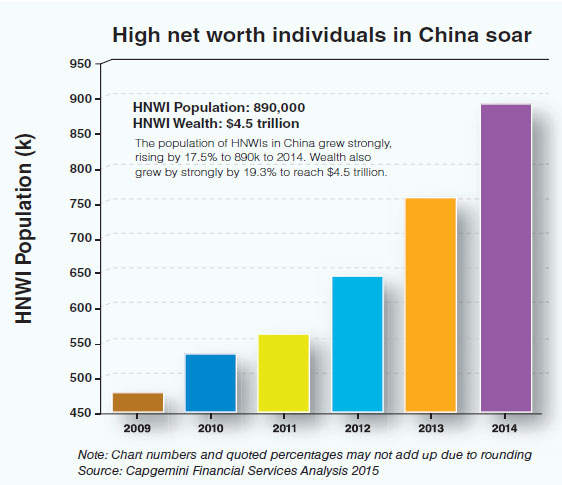
The report said the population of HNWIs in China grew strongly, rising 17.5 percent to 890,000 in 2014. Wealth also grew strongly, by 19.3 percent to $ 4.5 trillion.
The study indicated that the wealthy in Asia tend to have more cash and borrow more, especially for investments.
"The report showed that cash remains the largest asset class in Asia-Pacific (excluding Japan), setting the region apart from the rest of the world where equities are dominant. Keeping cash on hand provides financial security in case of market volatility as well as helping with any lifestyle demands.
"Compared to their peers globally, Asia-Pacific HNWIs like to hold credit in their portfolios. HNWIs in China are especially interested in credit for investments, with nearly 68 percent of credit used for investments. The use of leverage has always been high in the region, partly because many of the HNWIs are business owners who feel comfortable using credit," said Yong-Haron.
Even though Asia inched ahead in the number of HNWIs, North America retains the most money, with 28.8 percent of the $56.4 trillion of wealth in the world held by the affluent, ahead of 28.1 percent in Asia-Pacific and 23 percent in Europe.
paulwelitzkin@chinadailyusa.com
(China Daily USA 09/17/2015 page2)
- UN chief: Those blocking fleeing refugees should 'stand in their shoes'
- Hungarian riot police detain migrants
- IOC announces five cities bid for 2024 summer Olympic
- Japan opposition to halt vote on security bills
- Japan protesters rally as security bills near passage
- Australia launches first air strikes against IS

 Popular Chinese dishes in the US
 Evacuation ordered after M8.3 earthquake hits Chile’s coast
 Donate sperm to get an iPhone 6s
 NYFW: Anna Sui Spring/Summer 2016 collection
 Five unorthodox majors that could create a successful business
 Four major meetings between Xi and Obama since 2013
 Ice cube bath sets world record
 Chinese noncommercial ads to be displayed in the US
Most Viewed
Editor's Picks

|

|


|

|
|

|
Today's Top News
Xi to press case for Bilateral Investment Treaty
Australian dad takes on Chinese drug dealers after son’s death
Senior official at securities watchdog under investigation
Sequel of Crouching Tiger's underway but without Ang Lee
Action on climate heats up in LA
Fire traps more than 100 kids in East China building block
President Xi to visit US and attend UN summit in late September
2015 US-China Climate Leaders Summit kicks off
US Weekly

|

|